



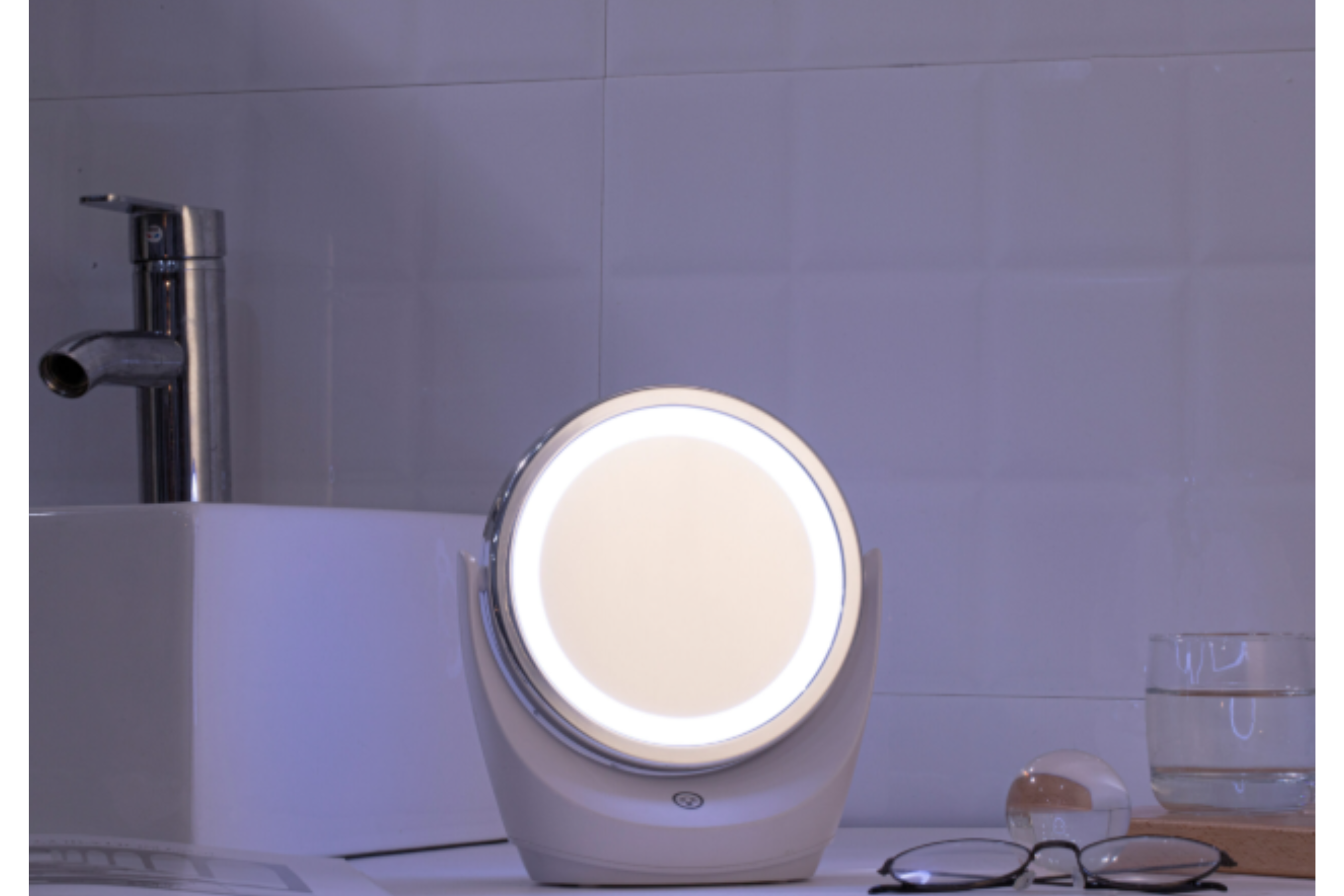
In the modern makeup process, LED makeup mirrors have become an indispensable must-have item, favored by both ordinary beauty enthusiasts and professional makeup artists for their adjustable lighting that simulates a professional makeup table. This kind of mirror can be used for fine operation, whether it is to outline the delicate eyeliner or to create a natural look. But as its usage continues to soar, an urgent question has surfaced: Are led makeup mirrors harmful to your eyes?
If you are worried that lighted mirrors are bad for your eyes, this article will honestly answer questions related to eye health. We will distinguish between facts and rumors, deeply analyze the key factors that affect eye safety, and provide practical tips to help you protect your eyes when using LED makeup mirrors.

To answer this question, it is necessary to first dismantle the working principle of such mirrors and the core reasons for the controversy surrounding eye health. LED makeup mirrors rely on light-emitting diodes to provide focused, high-definition illumination, which is crucial for delicate operations in makeup. Unlike traditional light bulbs, LED lights have the advantages of energy efficiency and durability, and their brightness and color temperature can be freely adjusted to adapt to various usage environments.
However, these advantages may translate into eye health hazards in cases of poor design or improper use. The specific reasons are as follows:
Poor quality LED makeup mirrors will omit the diffusion panel and directly use exposed high brightness LED lights, which emit concentrated and glaring light. This will force the pupil to contract for a long time, increase the burden on the eyes, and subsequently cause problems such as dryness, burning sensation, or temporary blurred vision in the eyes. People who wear contact lenses or suffer from dry eye syndrome are more susceptible to the impact.
LED lights emit blue light with a wavelength of 400-500 nanometers, which has extremely strong penetration and can reach deep into the retina. Long term excessive exposure may damage retinal cells and inhibit the secretion of melatonin, which regulates sleep, indirectly exacerbating eye fatigue.
When applying makeup, people usually hold their faces close to the mirror, and the duration of a single use can reach 15-45 minutes. This close and prolonged contact can amplify the intensity of light, causing the eye muscles to overwork, which can easily lead to chronic fatigue, headaches, or neck tension.
The cheap makeup mirror uses PWM to adjust brightness, which can produce flicker that is invisible to the human eye but perceptible to the brain, causing fatigue. In addition, uneven distribution of light can also create a situation where strong light areas coexist with shadows, forcing frequent blinking to adjust and further increase the burden on the eyes.

Facing the core question: Are LED makeup mirrors bad for your eyes? Are makeup mirrors worth it? The answer is: Poor quality products may pose risks, but high-end brand products are professionally designed and very safe for the eyes.
Low cost makeup mirrors cut corners in eye protection and pose significant risks, which have been investigated and studied.
In 2022, the Journal of Ophthalmology tracked 120 participants who used unfiltered LED lenses for daily makeup experiments. After only 20 minutes of use, 30% of the experimental personnel experienced symptoms such as dry eyes, redness, and blurred vision. For people who use it for more than 30 minutes a day, the symptoms will last until the afternoon, including difficulty focusing on the screen and tension headaches. Research suggests that this is due to its high light intensity of over 1500 lux, which is three times the recommended value for indoor close range work. The ciliary muscle contracts for a long time, similar to the soreness caused by the muscle maintaining a fixed posture for a long time.
A study by the American Academy of Ophthalmology in 2023 showed that the blue light emitted by low-quality LED lights can penetrate the cornea and lens of the eye directly to the retina. If exposed for more than 8 hours a day, it will produce reactive oxygen species in the long run, damage retinal photoreceptor cells, and increase the risk of AMD. Specifically, the blue light intensity of cheap LED makeup mirrors typically exceeds 1000 nanowatts per square centimeter, while the safety threshold set by international safety standards such as IEC is only 300 nanowatts per square centimeter.
When patients with dry eye syndrome use unfiltered LED lenses, the strong light emitted will accelerate the evaporation of tears, making symptoms such as gravel and burning even worse. Astigmatic individuals may find glare unbearable and distracting due to irregular corneal shape and more severe light scattering. People with myopia are already prone to eye fatigue due to working at close range, and facing glaring lights will further increase the burden on their eyes.
A sleep study conducted by Harvard Medical School has confirmed that using bright LED makeup mirrors within 2 hours before bedtime can inhibit melatonin secretion and disrupt circadian rhythms. Lack of sleep not only makes people tired, but also affects the process of eye repair. Long term nighttime use of mirrors leading to sleep deprivation can cause persistent dry eyes and decreased tear film quality, thereby increasing the risk of eye fatigue the next day.

Reputable brands like WELLAND integrate scientific design concepts, completely avoiding the aforementioned risks without affecting performance, and prioritizing eye safety.
The thick frosted diffusion panel can evenly scatter LED light, avoiding the formation of concentrated beams. Paired with anti glare coated glass, the final light intensity is stable at 300-500 lux. This is exactly the recommended range of close range working light by ophthalmologists, with a texture close to soft natural sunlight. A consumer study in 2023 showed that 92% of buyers who switched from affordable mirrors to high-quality makeup mirrors reported a 75% reduction in eye fatigue symptoms even after applying makeup for up to 45 minutes.
The LED light has been calibrated and meets international standards, controlling the blue light intensity in the harmful wavelength range of 400-450 nanometers within 250 nanowatts per square centimeter. The key is to reduce blue light without sacrificing color reproduction: the CRI of the mirror is as high as 95, ensuring that the makeup color is consistent with the real environment. This balance is crucial for beauty enthusiasts, as it not only safeguards eye health but also ensures that the makeup naturally fits in daily scenes with peace of mind.
To eliminate PWM flicker that is invisible to the human eye, high-end brands will use constant current drive technology to provide stable current for LED lights. The flicker level reaches level 1, which is the highest safety level. For users who are sensitive to light fluctuations, this stability can avoid hidden fatigue caused by flicker, and there will be no discomfort even after long-term use.
The LED makeup mirror holder is specially designed to fix the mirror surface 12-18 inches away from the face, ensuring clarity while minimizing light intensity. Some models also come with a built-in 20 minute timer, which will issue a gentle reminder when the time is up to avoid prolonged close eye use. In addition, the mirror base is wide and stable, which can prevent tilting and prevent users from approaching to adapt to unstable mirror surfaces.
Many high-end brands support brightness adjustment, allowing users to flexibly adjust according to the ambient light without using the highest brightness in dim rooms. They also offer three color temperature modes: warm light is suitable for night use, natural light ensures natural makeup in outdoor scenes, and cool light is suitable for short-term viewing of makeup effects in strong light environments. This customized design allows users to avoid unnecessary exposure to strong light.

Many users are confused about whether backlit mirrors are good for makeup and see them as a safer alternative. Backlit makeup mirrors are a popular category of LED makeup mirrors, which embed LED lights around the frame to emit soft indirect light instead of a concentrated beam. Therefore, the answer is undoubtedly yes. They not only protect the eyes but also improve makeup accuracy, making them a better choice.
The backlight makeup mirror provides even and shadow free light to avoid fatigue caused by frequent eye adjustments. The glare free design simulates soft natural light, making it suitable for sensitive eyes or long-term makeup scenes. And the CRI is greater than or equal to 90, the color reproduction is realistic, ensuring that the makeup naturally fits in different environments, while reducing the need to get close to the mirror and relieving the burden on the eyes.
When choosing, prioritize models with adjustable brightness and color temperature (3000K-6000K) to avoid products with exposed LED lights or no anti glare coating for the best user experience.
Stick to Safe Brightness: Use the eye safety preset mode to avoid adjusting to the highest brightness.
Choose Warm Light at Night: Choose the 3000K-3500K warm light mode to reduce exposure to blue light.
Maintain a safe distance: Secure the mirror at 12-18 inches. If you need to zoom in on details, use the 3-5 times magnification function instead of getting close to the mirror.
Follow the 20-20-20 rule: Every 10 minutes of use, spend 30 seconds looking at objects 20 feet (about 6 meters) away and relax your eye muscles.
Keep It Clean: Wipe the anti glare glass with a microfiber cloth to avoid light scattering caused by stains.
The answer to the question of whether LED makeup mirrors are bad for your eyes depends on the quality of the product: inferior products pose health risks, but high-end products such as WELLAND can effectively protect eye safety through scientific design. WELLAND proves that LED makeup mirrors can enhance the makeup experience without harming health.
When making a purchase, prioritize the core features: diffused light, low blue light that meets international standards, flicker free design, and adjustable brightness and color temperature. Combining simple usage habits can effectively protect eye health.
When faced with the dilemma of “are LED mirrors good for makeup” or “are LED mirrors worth it“, eye safety becomes the core selection criterion. A high-quality LED makeup mirror is not only an investment in creating exquisite makeup looks, but also a guarantee for protecting long-term vision. Beauty should not come at the cost of health. By choosing the right product, you can enjoy the convenience and precision of LED lighting while keeping your eyes safe and comfortable at all times.
Q1: How to choose a gentle LED makeup mirror for the eyes?
A1: Priority attention to core features: Color rendering index (CRI) ≥ 90 to ensure color accuracy, adjustable brightness (ideal range of 300-500 lux), low blue light certification, anti glare coating, and flicker free design.
Q2: Are lighted mirrors bad for your eyes?
A2: Only poorly designed products will. The high-end brand’s illuminated makeup mirror adopts diffused light, low blue light, and flicker free technology, which can be safely used in daily life.
Q3: Which is more eye friendly, warm light or cold light?
A3: Warm light (3000K-3500K) has low blue light content, making it more suitable for use at night; Natural light (4500K) is the best choice for daytime makeup, ensuring that the makeup color matches the real environment.
Q4: How long is the safest time to use an LED makeup mirror?
A4: It is recommended to limit the duration of a single use to 20-30 minutes. Pause for 30 seconds every 10 minutes and gaze at distant objects (following the 20-20-20 rule) to relieve eye fatigue.
Q5: Can LED makeup mirrors cause long-term eye damage?
A5: No. There is a long-term risk of damage to poorly designed products. A high-quality LED makeup mirror with low blue light, diffused light, and flicker free technology, safe for daily use.
 EN
EN  RU
RU  PT
PT  FR
FR  ES
ES  KO
KO  JA
JA  DE
DE  ZH
ZH