



Sourcing personal care products from China can be a game-changer for your brand—lower costs, scalable capacity, and mature supply chains. But it also carries real risks: substandard quality, delayed shipments, compliance gaps, and suppliers that overpromise and underdeliver.
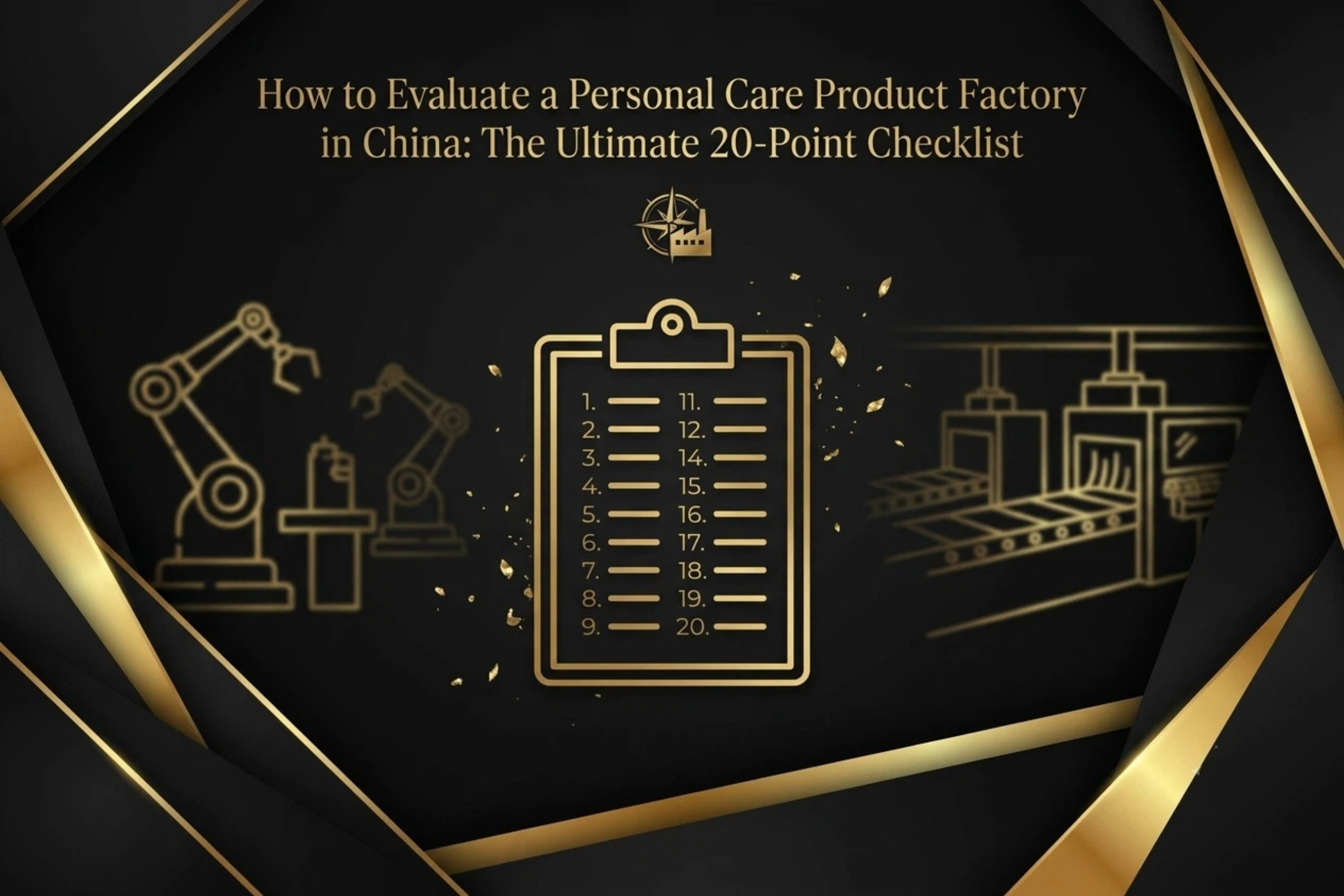
This 20-point factory evaluation checklist is built for B2B buyers, brand owners, and sourcing managers who need a systematic way to vet personal care product manufacturers in China before signing a contract.
Many B2B buyers focus on unit price first. That is a costly mistake. A factory with a slightly higher unit cost but strong quality systems, reliable delivery, and valid certifications will cost you less in the long run than a cheap supplier that triggers a product recall or misses your peak season deadline.
A proper factory evaluation in China has three goals:
Request a copy of the business license and verify it through official channels or a third-party verification service. Check that the business scope covers the product categories you are sourcing. A legitimate factory will have no issue providing this document.
Ask for the factory’s property deed or lease agreement for the production facility. Trading companies often pose as factories. A site visit or live video factory tour is the most reliable way to confirm actual manufacturing capabilities.
ISO 9001 certification indicates the factory has documented quality management processes. Ask for the certificate, verify the scope covers your product type, and check the issuing body is accredited (e.g., SGS, TÜV, BV).
Personal care electronics (water flossers, facial brushes, etc.) typically require CE, FCC, or RoHS for the European and US markets. Verify that certifications are issued to the factory’s name—not a generic trading company—and that they are current.
Ask for the factory’s monthly production capacity for your product category and compare it with your projected order volumes. A factory operating at 80-90% capacity may struggle with rush orders. Ideally, choose a factory with 30-50% spare capacity for flexibility.
Newer equipment (injection molding machines, SMT lines, assembly lines) generally means better consistency and fewer defects. During a factory visit, note the equipment age and maintenance logs. Well-maintained equipment is a strong signal of management discipline.
Factories that outsource critical processes (e.g., PCB assembly, molding) have less control over quality and lead times. Ask for a process flowchart and identify which steps are done in-house. More in-house control typically means better consistency.
A reliable factory can show you written QC procedures: incoming material inspection (IQC), in-process quality control (IPQC), and final quality control (FQC). If they cannot produce these documents, that is a red flag.
Ask for the factory’s historical defect rates by product line over the past 12 months. A defect rate below 1-2% is typical for mature personal care product lines. If the factory cannot provide this data, they are not measuring it systematically.
A factory confident in its capabilities will provide samples quickly (7-14 days) and at reasonable cost (often deductible from the first order). Long sample lead times or refusal to provide pre-production samples are warning signs.
Understand the factory’s standard MOQ and whether they offer flexibility for new product launches or pilot runs. Some factories offer lower MOQs for existing SKUs with minor customization—this can be a good way to start a relationship.
Ask for case studies or references from brands in your target market (North America, Europe, etc.). A factory with experience serving your market understands the compliance requirements, packaging expectations, and quality standards that matter to your customers.
If you need custom product development, assess the factory’s R&D team size, patent portfolio, and new product launch history. A factory with strong R&D can help you differentiate your product rather than selling a commodity.
Ask how the factory traces components and raw materials. Can they provide material Certificates of Compliance (CoC) for key components? Traceability matters for both quality control and regulatory compliance.
A factory under financial stress may cut corners on materials or delay payments to suppliers, creating ripple effects for your orders. While sensitive, asking for credit reports or audited financial statements from long-term partners is reasonable for large-volume commitments.
Verify the factory can provide complete export documentation: commercial invoice, packing list, certificate of origin, and Bills of Lading. Factories experienced in export will also be familiar with Incoterms and can advise on the most cost-effective shipping terms.
Poor communication is one of the most common causes of sourcing failures. Assess whether the factory has dedicated English-speaking sales and engineering staff who can respond to technical questions accurately and promptly.
If you cannot visit the factory yourself, commission a third-party audit (SGS, Intertek, TÜV). A recent audit report covering social compliance, quality systems, and production capacity is far more reliable than a factory’s self-reported data.
Clarify how the factory handles defective products after shipment. Do they offer replacement stock? Do they share the cost of quality-related returns? A factory willing to stand behind their products is a stronger long-term partner.
Ask for references from existing clients, ideally in a similar business scale or market. High client retention rates (80%+) indicate consistent performance. Be wary of factories that refuse to provide references or only offer generic testimonials without contactable references.
Once you have evaluated multiple factories using the 20-point checklist, create a weighted scoring matrix. Not all points carry equal weight:
| Evaluation Area | Weight (Recommended) | Key Points from Checklist |
|---|---|---|
| Certifications & Compliance | 20% | Points 3, 4, 14 |
| Production Capacity & Equipment | 20% | Points 5, 6, 7 |
| Quality Control Systems | 25% | Points 8, 9, 19 |
| OEM/ODM & R&D Capability | 15% | Points 12, 13 |
| Business Legitimacy & Stability | 10% | Points 1, 2, 15 |
| Communication & Service | 10% | Points 10, 11, 17 |
Use a 1-5 scoring scale for each point, multiply by the weight, and compare total scores across factories. This removes gut-feel bias and gives you a defensible basis for supplier selection.
A live video tour (via WeChat, Zoom, or WhatsApp video) is a good first step and can reveal obvious red flags. However, for large-volume or long-term partnerships, an in-person visit by you or a trusted third-party inspector is strongly recommended. Many issues—like actual working conditions, inventory management, and equipment maintenance—are difficult to assess remotely.
OEM (Original Equipment Manufacturer) means you provide the product design and specifications, and the factory manufactures it. ODM (Original Design Manufacturer) means the factory provides existing product designs that you can brand and customize. ODM is faster to market; OEM offers more differentiation. Choose based on your brand strategy and internal design capabilities.
Evaluate at least 3-5 factories for any significant sourcing project. This gives you comparative data on pricing, capabilities, and service levels. Fewer than 3 limits your negotiation leverage; more than 5 can become difficult to manage. Use the 20-point checklist to narrow down to 2-3 finalists before requesting formal quotations.
Yes, in some cases. Trading companies can offer access to multiple factories, faster response times, and better English communication. However, they add a margin layer and have less direct control over production. If you choose a trading company, verify which factory will actually produce your goods and apply the same evaluation criteria to that factory.
At minimum, include: (1) detailed product specifications as an annex, (2) acceptable quality limit (AQL) levels, (3) pre-shipment inspection rights, (4) defective product replacement timeline and cost allocation, (5) IP protection and confidentiality clauses, and (6) clear payment terms tied to quality acceptance milestones rather than just shipment dates.
Beyond the checklist, several tools can make your evaluation more systematic:
Choosing a personal care product factory in China is not a one-time transaction—it is the beginning of a manufacturing partnership that will affect your brand reputation, profit margins, and customer satisfaction for years. Use this 20-point checklist not as a one-off form, but as an ongoing evaluation framework as the relationship develops.
The best factories are not always the cheapest, and they are not always the ones with the fastest responses. They are the ones that treat your quality standards as seriously as you do.
WELLAND offers ISO-certified manufacturing, in-house R&D, and full OEM/ODM support for personal care brands worldwide.
Get a free factory evaluation summary and custom quotation for your next product line.
This blog post is for informational purposes only. Always consult with legal and sourcing professionals before entering into manufacturing agreements.
 EN
EN  RU
RU  PT
PT  FR
FR  ES
ES  KO
KO  JA
JA  DE
DE  ZH
ZH