



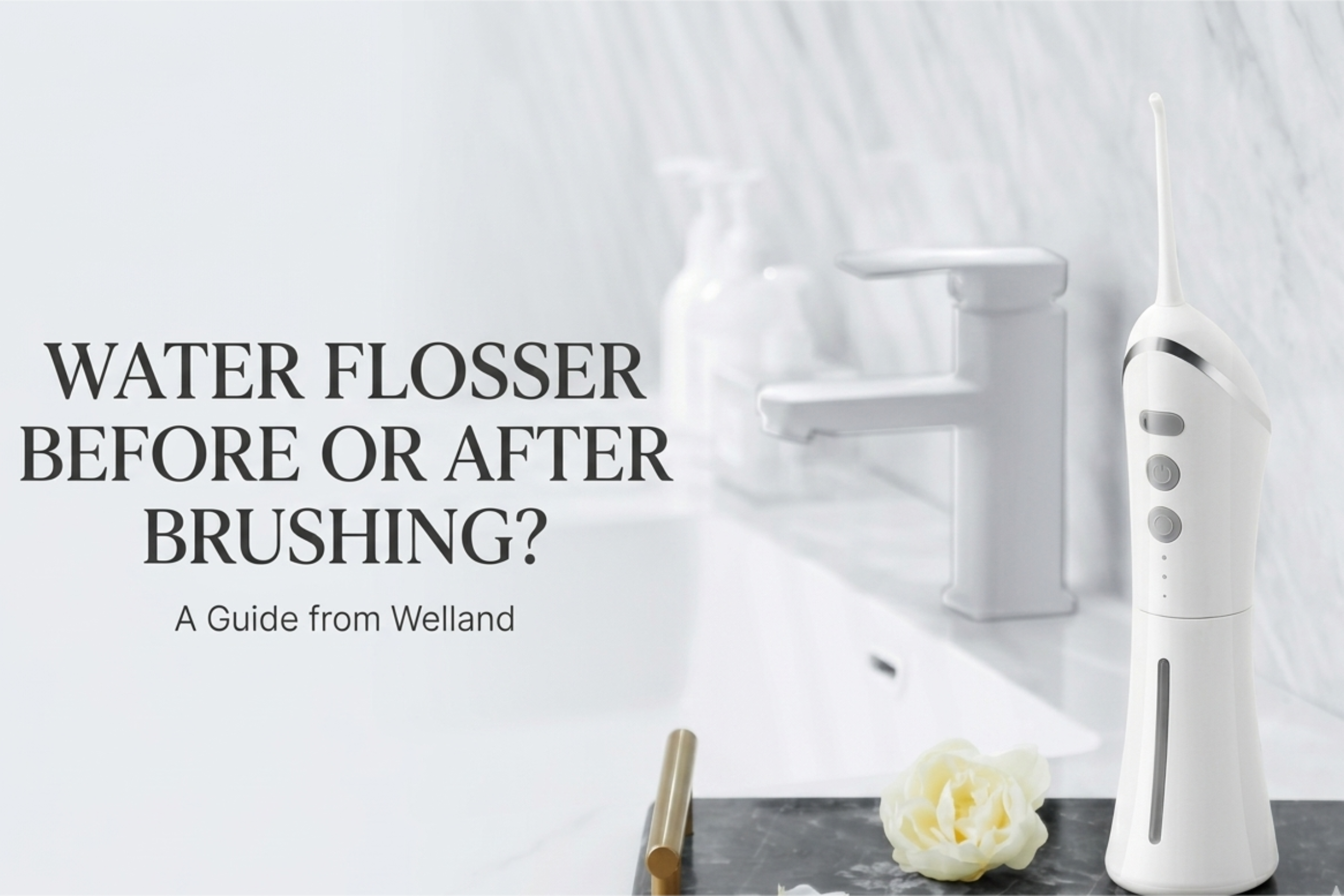
If you’re a retailer, distributor, or brand looking to stock or private-label water flossers, understanding how the product is correctly used by end consumers directly impacts customer satisfaction, product reviews, and repeat sales. At WELLAND, as a leading OEM/ODM water flosser manufacturer, we believe that product education is part of the value we offer. This guide gives your team — and your customers — a clear, science-backed answer to one of the most commonly asked oral care questions.
The sequence of your oral hygiene routine isn’t just a personal preference — it has a measurable impact on how effectively you remove plaque, protect enamel, and prevent gum disease. Brushing and flossing each target different areas of the mouth, and doing them in the right order ensures neither step cancels out the other.
When you brush your teeth first without removing food particles between them, your toothbrush pushes some debris deeper into tight spaces. Conversely, water flossing first flushes out loose food and softens plaque, giving your toothbrush a cleaner surface to work on — and allowing fluoride toothpaste to coat more of your tooth surface after.
A study published in the Journal of Periodontology found that participants who flossed before brushing retained significantly higher fluoride levels in their mouths after the routine, suggesting stronger enamel protection. This same principle applies to water flossing: using your water flosser before brushing optimises the overall effectiveness of your routine.
Using a water flosser before you brush your teeth offers several clinical and practical advantages:
For users who are new to how to use a water flosser, starting the routine with the water flosser tends to feel more intuitive — and making it a habit is easier when it comes first.
Water flossing after brushing is absolutely still beneficial — and for many users, it feels like the natural “finishing step” of their oral care routine. Here’s what this approach offers:
The most important takeaway: whether you use the water flosser before or after brushing, using it consistently every day delivers results. Both sequences reduce plaque, support gum health, and improve overall oral hygiene when compared to brushing alone.
While flexibility matters, here is the routine order most supported by dental professionals and clinical research:
This four-step sequence is particularly effective for users with dental implants, crowns, or orthodontic appliances, where conventional string floss alone often fails to reach critical cleaning zones. Understanding how a water flosser works helps both retailers and end users appreciate why it’s an essential — not optional — part of this sequence.
One reason the WELLAND water flosser range is trusted by B2B buyers across global markets is the breadth of tip options, each designed for a specific oral health need. Matching the right water flosser tip to the user’s situation makes a significant difference in both comfort and effectiveness:
For B2B buyers considering OEM/ODM water flosser solutions, offering a multi-tip product line significantly increases perceived product value and broadens the target consumer base — from general users to those with orthodontic needs, dental implants, or periodontal concerns.
A common question among consumers — and one that affects purchasing decisions — is whether a water flosser replaces traditional floss. The short answer is: they work best together.
String floss — particularly waxed floss — physically wraps around the curved surface of each tooth and scrapes plaque in a way that water pressure alone may not fully replicate in all situations. Water flossing, however, reaches below the gum line more effectively than string floss (studies show water flossers can reduce bacteria up to 6mm deep, compared to the more limited reach of traditional floss), and is far more practical for users with braces, implants, or dexterity limitations.
The ideal recommendation for end consumers:
For users with receding gums or gum disease, water flossing is often the gentler, more sustainable option compared to aggressive string flossing.
Certain consumer segments benefit most from adopting water flossing into their routine — and these are exactly the B2B market segments where WELLAND water flossers deliver the highest customer satisfaction:
Implants crowns and fixed bridges require daily cleaning around the base and beneath the gum line. String floss often struggles with the contour of implant crowns, but a water flosser directed at a 90-degree angle along the gum margin provides thorough, gentle cleaning without risking damage to the restoration.
Braces trap food particles at every bracket and under every wire — areas completely inaccessible to a standard toothbrush. The orthodontic tip makes the WELLAND water flosser a clinical-grade complement to brushing for this segment.
Users prone to bleeding gums or gum disease often find traditional floss uncomfortable or painful. Starting at a low pressure setting on the WELLAND water flosser and gradually increasing as the gums strengthen is a well-established approach recommended by dental hygienists. Learn more about how a water flosser can help prevent receding gums.
For elderly users or those with arthritis, threading string floss between teeth can be physically difficult. A cordless water flosser with an ergonomic handle offers an accessible, equally effective alternative.
Getting the technique right ensures users experience the full benefit of water flossing. Here is the standard approach, suitable for most WELLAND water flosser models:
For a more detailed walkthrough, see our full guide on how to use a water flosser. And to keep your device performing optimally, read our guide on how to clean a water flosser.
| Sourcing Water Flossers for Your Brand? WELLAND is a certified OEM/ODM water flosser manufacturer with ISO9001, CE, FCC, and RoHS compliance. We support custom branding, multi-tip configurations, and private label production with MOQ from 3,000 units. |
Both options work, but most dental professionals recommend using a water flosser before brushing. Doing so removes food particles and loosens plaque, allowing your toothbrush and fluoride toothpaste to clean more effectively and protect enamel better.
A water flosser is highly effective at flushing debris and bacteria from between teeth and below the gum line, but it works differently from string floss. Traditional floss or waxed floss physically scrapes plaque from tooth surfaces. For optimal oral health, using both is ideal — though a water flosser alone is far better than skipping interdental cleaning altogether.
Once daily is the standard recommendation for most users. Those with braces, dental implants, gum disease, or deep periodontal pockets may benefit from twice-daily use. Your dentist can advise based on your specific oral health needs.
Yes. In fact, water flossers are often specifically recommended for users with implants, crowns, and fixed bridges because the gentle pulsating stream can clean the margins around implants without damaging the restoration — something string floss may struggle to do.
New users should always start at the lowest pressure setting and increase gradually until reaching a level that feels thorough but comfortable. Users with sensitive gums or who have recently had dental work should maintain a lower setting for several weeks before adjusting.
A small amount of mouthwash can be added to the water reservoir for additional freshness. However, always run plain water through the unit afterwards to flush the internal components and prevent residue buildup that may reduce performance over time.
A full water flossing session should take approximately two minutes — enough time to systematically clean between each tooth and along the entire gum line, including back molars.
Standard tips should be replaced every three to six months. Orthodontic tips and specialised bristle-based tips should be replaced every three months, as the bristles splay and lose effectiveness with regular use — similar to a toothbrush.
Yes, children can use a water flosser under adult supervision. Starting at the lowest pressure setting is essential. Water flossers can be a particularly effective tool for children or teenagers with braces who find string flossing difficult or time-consuming.
Countertop models typically offer a wider range of pressure settings and larger water reservoirs, making them suitable for users who prefer maximum control and power. Cordless water flossers are portable, rechargeable, and ideal for travel or smaller bathrooms. Both deliver clinically effective water flossing when used correctly.
The debate over whether to use a water flosser before or after brushing ultimately resolves to this: the best sequence is the one your customers will actually stick to. For clinically optimal results, using the water flosser first — followed by string floss and then brushing — gives the most thorough clean and maximises the protective benefit of fluoride toothpaste.
For retailers, dental distributors, and private-label brands, educating consumers on correct water flosser usage directly translates into higher product satisfaction, stronger reviews, and greater brand loyalty. At WELLAND, we support our B2B partners not just with certified, high-quality water flosser manufacturing, but with the technical and educational resources to help your brand succeed in market.
| Partner With WELLAND — Your Trusted Water Flosser OEM/ODM Manufacturer ISO9001 certified · CE, FCC & RoHS compliant · Custom branding & private label · MOQ from 3,000 units · Multiple tip configurations available |
 EN
EN  RU
RU  PT
PT  FR
FR  ES
ES  KO
KO  JA
JA  DE
DE  ZH
ZH