

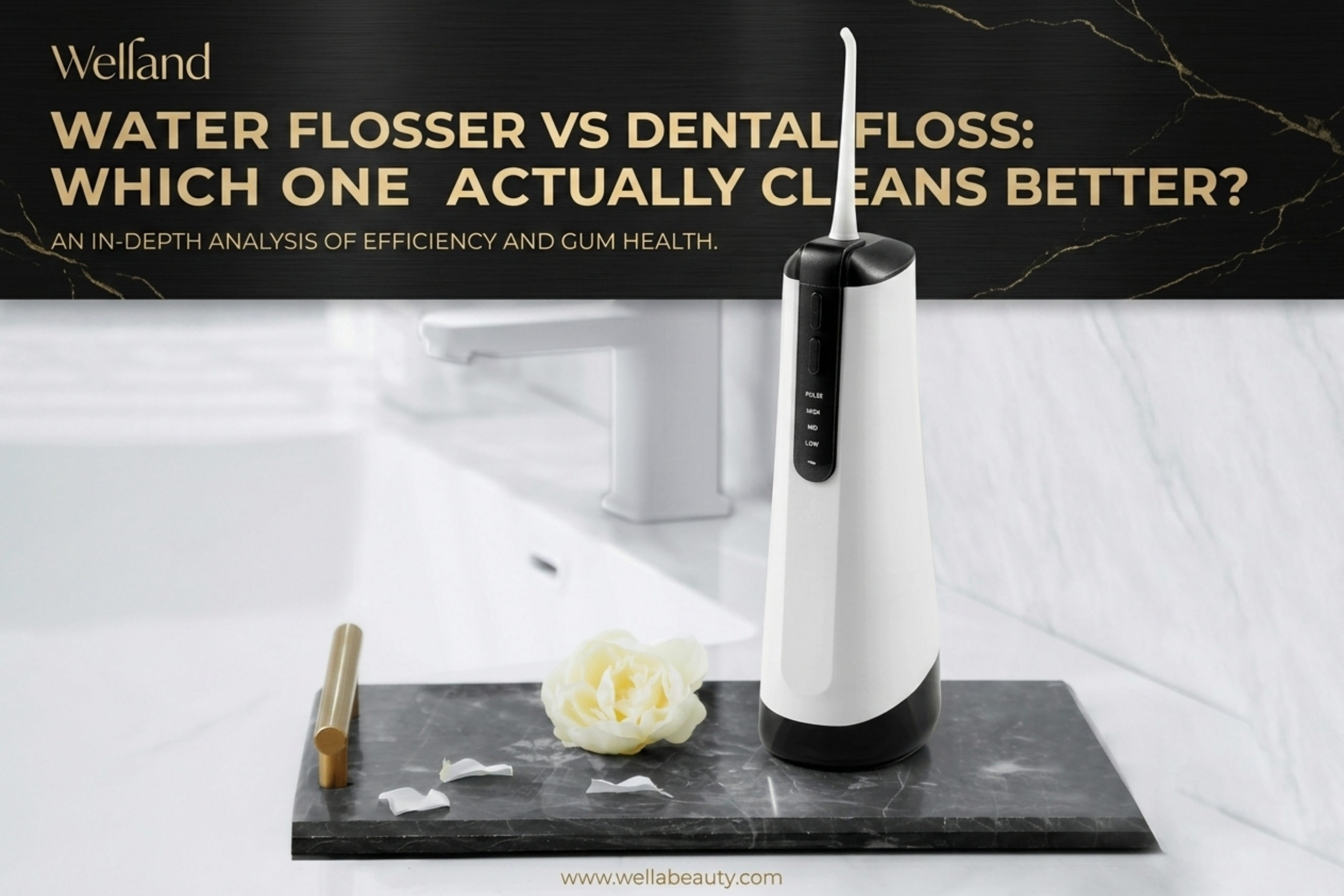
When it comes to oral hygiene, brushing alone is never enough. Yet the debate over water flosser vs dental floss continues to grow louder — especially as water flosser technology improves and consumer awareness rises. For B2B buyers, retailers, and brand owners sourcing oral care products, understanding the real differences between these two interdental cleaning methods is essential for serving your end customers well and staying competitive in a fast-growing market.
This guide provides a thorough, evidence-based comparison of water flosser vs dental floss — covering plaque removal, gum health, ease of use, cost, and the specific scenarios where each tool excels.
Traditional dental floss — also called regular floss or string floss — is a thin thread, either waxed or unwaxed, that you slide between your teeth to physically dislodge food debris and scrape away plaque buildup along and below the gumline. The American Dental Association (ADA) has long positioned traditional string floss as the baseline standard for interdental cleaning.
A water flosser — also known as an oral irrigator or dental water jet — is a handheld or countertop device that delivers a targeted, pulsating stream of water between your teeth and gums to remove food particles and disrupt plaque buildup. Unlike traditional string floss, it relies on water pressure rather than mechanical scraping.
Modern water flosser designs — such as the Welland cordless water flosser range — include multiple pressure settings, specialised tip attachments (orthodontic, implant, periodontal), and rechargeable lithium batteries for wireless convenience.
| Criteria | Dental Floss | Water Flosser |
|---|---|---|
| Plaque Removal | Excellent mechanical scraping action | Excellent — comparable or superior in clinical studies |
| Gum Disease Prevention | Effective with correct daily technique | Highly effective; gentler on inflamed gum tissue |
| Ease of Use | Requires dexterity and technique | Simple, one-handed operation |
| Suitable for Braces | Difficult; requires threader | Excellent — highly recommended |
| Suitable for Implants | Possible but risks snagging | Excellent with implant tip |
| Portability | Very high — pocket-sized | Moderate — cordless models improving rapidly |
| Cost (upfront) | Very low (under $5) | Moderate–High ($30–$100+) |
| Cost (ongoing) | Ongoing consumable cost | Low — only tip replacement every 3–6 months |
| Environmental Impact | Daily plastic waste | Minimal ongoing waste |
| ADA Acceptance | Yes — gold standard | Yes — ADA-accepted as effective |
One of the most common questions in oral care is whether a water flosser vs string floss performs better at removing plaque. The scientific evidence is nuanced:
A 2013 study found water flossers were 29% more effective than traditional string floss at overall plaque removal. A 2021 study found water flossing was equally effective, though not significantly superior. The consistent finding across studies is that both methods meaningfully reduce plaque and gum bleeding when used consistently as part of a daily oral hygiene routine.
The key takeaway for product buyers: the best interdental tool is the one your customer will actually use every day. For consumers who find string flossing uncomfortable or technically challenging, a water flosser dramatically increases the likelihood of daily compliance — which is ultimately what drives better oral health outcomes.
This is where water flossers deliver their most clear-cut advantage. Threading traditional floss through orthodontic wires is time-consuming and risks breakage. An oral irrigator can flush food debris and disrupt plaque buildup around brackets and wires in seconds. For retailers targeting the orthodontic segment, stocking a water flosser for braces users represents a significant market opportunity.
Patients experiencing early-stage gum disease (gingivitis) or post-periodontal treatment often benefit from water flossers, which flush bacteria from gum pockets without the trauma of string dragging against inflamed tissue. Multiple pressure settings allow users to customise the experience as their gum health improves.
String floss can snag on implant posts and leave fibres behind. Water flossers with dedicated implant tips clean around the post and crown gently and thoroughly — making them a preferred recommendation for post-implant oral care.
For older adults or those with arthritis, gripping and manipulating string floss is genuinely difficult. A water flosser with an ergonomic handle removes this barrier entirely, enabling consistent daily oral hygiene without assistance.
There is no universal winner in the dental floss vs water flosser debate — and that is exactly the point for product buyers and distributors.
The American Dental Association endorses both tools. Dental professionals increasingly recommend using them together: traditional flossing for its mechanical scraping precision on smooth tooth surfaces, combined with water flossing to flush deeper gum pockets and reach areas string cannot. Together, they represent the most comprehensive approach to removing plaque, preventing gum disease, and maintaining long-term oral health.
For end consumers who will not consistently use string floss, a water flosser is not just a substitute — it is a meaningful upgrade. And for B2B buyers building product ranges, understanding both ends of this spectrum means better category coverage, stronger retail proposals, and more satisfied end customers.
Neither is categorically better — they work differently. Dental floss physically scrapes plaque from tooth surfaces; a water flosser flushes bacteria and debris from gum pockets. Used together, they deliver the most thorough oral care.
For most people, combining both is ideal. However, for those who absolutely will not use string floss, a water flosser is a clinically validated alternative that significantly improves oral health over no interdental cleaning at all.
Studies show comparable effectiveness, with some evidence that water flossers remove up to 29% more plaque overall. String floss may have a slight edge on smooth, flat tooth surfaces.
Yes — this is one of the strongest use cases for a water flosser for braces. It quickly and effectively cleans around brackets and wires where string floss is difficult to use.
Water flossers are often preferred for managing early gum disease because they gently flush bacteria from below the gumline without irritating already-inflamed tissue.
The ADA recommends cleaning between teeth every day. Daily use of a water flosser, ideally after you brush your teeth, is sufficient for most users.
Yes — a water flosser with an implant-specific tip is actually safer than string floss for implant patients, as it eliminates the risk of snagging or leaving fibres around the post.
They are the same device. Oral irrigator and water flosser are interchangeable terms for a device that uses a pressurised water stream to clean between teeth and gums.
Yes. Most modern water flossers offer multiple pressure settings. Starting on the lowest setting allows users with sensitive gums to adapt gradually, making water flossing accessible even for those prone to gum disease or post-treatment sensitivity.
Yes — water flossers are excellent at flushing food debris from between teeth and from gum pockets. For large particles lodged in tight spaces between teeth, the pressurised stream is often more comfortable and faster than traditional string floss.
Welland designs and manufactures cordless water flossers built for retail brands, private label programmes, and OEM partnerships. CE, FCC, RoHS certified. ISO 9001 & BSCI audited.
EXPLORE PRODUCTSREQUEST OEM CATALOGUE
MOQ-friendly. Global shipping. Custom branding available.



 EN
EN  RU
RU  PT
PT  FR
FR  ES
ES  KO
KO  JA
JA  DE
DE  ZH
ZH