

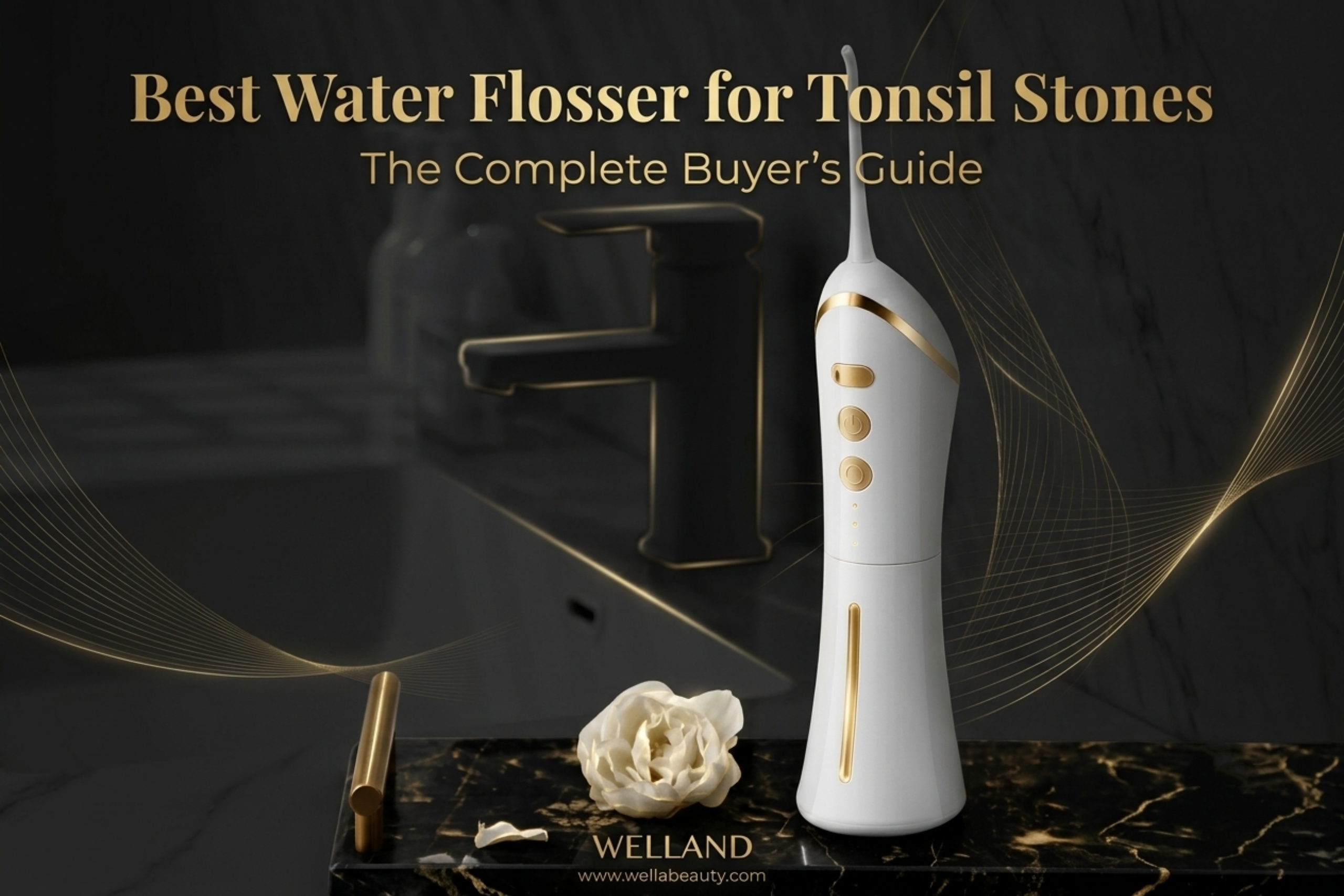
If your customers are searching for the best water flosser for tonsil stones, they are dealing with a real problem — and they are ready to buy a solution. Tonsil stones (tonsilloliths) affect a significant portion of adults worldwide, causing bad breath, throat discomfort, and persistent frustration. A targeted water flosser for tonsil stones is clinically recognised as one of the most effective at-home remedies available.
For B2B buyers — whether you are a private-label brand, a dental product distributor, or a retail chain looking to expand your oral care range — understanding what makes a water flosser genuinely effective for tonsil stone removal is the foundation of a profitable, repeat-purchase product category. This guide covers the science, the product specifications that matter, and how WELLAND helps partners bring the right products to market.
Tonsil stones, or tonsilloliths, form when food particles, dead cells, and oral bacteria become trapped in the crypts (small pockets) of the tonsils and gradually calcify into hard, white-yellowish deposits. They range in size from a grain of rice to, in severe cases, a small pebble.
Common symptoms include:
Tonsil stones are more common in people who have enlarged tonsils, suffer from chronic tonsillitis, or struggle with poor oral hygiene. Crucially, brushing your teeth alone does not remove tonsil stones — the tonsils sit in an area that a toothbrush simply cannot reach. This is precisely where a purpose-designed water flosser tonsil tool fills a critical gap in the oral care market.
Market Insight: Search volume for “water flosser for tonsil stones” and related queries has grown steadily as consumer awareness rises. Brands that offer a targeted solution — rather than a generic water flosser — command higher conversion rates and stronger brand loyalty in this sub-category.
Of all at-home remedies — including saltwater gargles, cotton swab pressure, and forceful coughing — a tonsil stone water flosser offers the most consistent, pain-free, and repeatable results. Here is why:
A pulsing stream of water directed precisely at the tonsil crypts dislodges stones without the need for physical contact. Unlike cotton swabs or fingers — which risk triggering the gag reflex or causing micro-injuries — a water flosser reaches deep into the crypts safely. Starting on the lowest water pressure setting is essential for the sensitive tonsil tissue.
A quality water irrigator for tonsil stones does more than remove existing stones. Used consistently, it flushes out the food debris and bacteria that would otherwise calcify into new stones — helping to actively prevent tonsil stones from forming in the first place.
Because tonsil stones are a primary driver of bad breath that does not resolve with conventional brushing, regular water flossing of the tonsil area addresses the root cause. This makes a water flosser with a dedicated tonsil mode a uniquely high-value product for halitosis sufferers.
Medical guidelines advise against squeezing or poking tonsil stones with sharp objects. A low pressure water flosser for tonsils is the safest self-care option, and it can be used daily without risk of tissue damage when operated correctly.
Not all water flossers are equally suited to tonsil stone removal. When evaluating products for your brand or retail range, prioritise the following specifications:
| Feature | Why It Matters for Tonsil Stones | Recommended Spec |
|---|---|---|
| Tonsil Stone Nozzle | An elongated, angled tip reaches the back of the mouth without discomfort or gagging | Dedicated tonsil nozzle / curved tip included |
| Water Pressure Range | Tonsil tissue is sensitive — gentle low settings for removal, higher for prevention rinse | 30–100 PSI with ≥3 modes including a dedicated tonsil / gentle mode |
| Water Tank Capacity | Sufficient volume to thoroughly irrigate both tonsils without mid-session refilling | 150 ml+ (portable) / 300 ml+ (countertop) |
| Easy to Fill Tank | Compliance drops fast if refilling is fiddly; removable, wide-mouth tanks drive daily use | Removable tank with wide opening; dishwasher-safe components |
| Cordless / Portable Design | Users prefer to use over a sink; cordless removes the tripping-hazard barrier to daily use | USB-C rechargeable; IPX7 waterproof; 20+ day battery |
| Pulse Frequency | Higher pulse rates (1,200–1,800 PPM) create micro-turbulence that loosens calcified stones more effectively than a steady stream | 1,200–1,800 pulses per minute |
| Certifications | Required for retail market access and consumer trust in oral health devices | CE, FCC, FDA (where applicable), RoHS, ISO 9001 |
Providing clear usage guidance alongside your product dramatically reduces returns and negative reviews. Here is the clinically aligned protocol to share with end users:
Fill the water tank
Use lukewarm water (not cold — cold water on sensitive tonsil tissue can be uncomfortable). Some users add a diluted, alcohol-free mouthwash for added antibacterial benefit. Fill to the maximum line on the easy to fill reservoir.
Attach the tonsil stone nozzle and select the lowest pressure setting
A dedicated tonsil nozzle — longer and slightly curved — allows precise targeting of tonsil crypts. Always begin with the lowest water pressure or the designated tonsil / gentle water flosser tonsil mode to avoid irritating delicate tissue.
Lean over a sink and aim the nozzle
Use a well-lit mirror or a phone camera for visibility. Hold the nozzle close to — but not directly touching — the tonsil stone. Leaning forward means a dislodged stone falls forward into the mouth or sink rather than being swallowed.
Apply water for 5–20 seconds per stone
Activate the water flosser and direct the pulsing stream of water at the stone for up to 20 seconds. If nothing dislodges, pause, rinse, and try again shortly. Never force the process or increase pressure dramatically.
Rinse both tonsils and finish with a preventive flush
After stone removal, do a gentle sweep of both tonsils with a slow, low-pressure rinse. This flushes away residual debris and bacteria — the step that makes daily use so effective at keeping tonsils stone-free long-term.
⚠️ Important Note for Product Packaging: Water flossers work best on soft, small tonsil stones. Larger, harder calcifications may require medical removal by an ENT specialist. Always include this guidance in user documentation to protect both the consumer and your brand.
At WELLAND, we specialise in OEM and ODM oral care devices for global brands, retail chains, dental distributors, and e-commerce sellers. Our water flosser platform is purpose-engineered for the demands of today’s oral health consumer — including those seeking a reliable water pick for tonsil stones.
WELLAND water flossers feature a gentle water flosser for tonsils operating mode specifically calibrated for tonsil crypt irrigation — distinct from the standard gum-cleaning mode. This is achieved through precision pulse-width modulation of the motor, not simply capping a powerful pump, ensuring consistent, gentle output that end users trust.
Our proprietary tonsil stone nozzle tip features an extended shaft with a 15° angled tip, enabling users to reach tonsil crypts comfortably without triggering the gag reflex. The nozzle uses a 360° rotation base, accommodating both left- and right-hand users across all anatomies.
The most effective cordless water flosser for tonsil stones is one users actually reach for every day. WELLAND’s platform delivers a 30-day battery life per charge, IPX7 waterproofing for use directly over the sink, and USB-C charging that fits the modern consumer’s existing cable ecosystem.
All WELLAND water flossers are CE, FCC, RoHS, and ISO 9001 certified, with FDA documentation available for relevant markets. We support full private-label customisation: housing colour, logo, nozzle branding, packaging, and user manual localisation for any target market.
The most compelling commercial case for a water flosser for tonsil stones is its role in prevention, not just removal. Consumers who experience relief from their first use are highly motivated to maintain the habit — creating exactly the kind of loyal, repeat-purchase behaviour that drives sustainable brand revenue.
Here are the evidence-backed prevention habits to highlight in your product marketing:
For brand partners, this positions the water flosser not as a one-time fix but as a core element of a daily oral care ritual — analogous to the electric toothbrush’s transition from novelty to household essential.
Ready to Launch Your Own Product?
WELLAND is a certified OEM/ODM manufacturer specialising in professional-grade water flossers. From private-label packaging to custom nozzle engineering, we help brands bring trusted, high-performance oral care solutions to market — fast.
CE · FCC · RoHS · ISO 9001 · BSCI Certified | MOQ from 3,000 units | Full Private Label Support
Deepen your knowledge of water flosser technology and oral care with these WELLAND guides — and suggested topics for your content calendar.
How Does a Water Flosser Work?
The complete mechanism guide — covers pulse frequency, pressure systems, and why water beats string floss.
How to Use a Water Flosser: Step-by-Step
Proper technique for everyday oral hygiene — a natural next read for tonsil stone sufferers building a new routine.
Can a Water Flosser Help Receding Gums?
Explores how gentle oral irrigation supports long-term gum and tonsil health — pairs perfectly with this guide.
How to Clean a Water Flosser
Maintenance guide that extends device life and keeps the tonsil nozzle hygienic for safe daily use.



 EN
EN  RU
RU  PT
PT  FR
FR  ES
ES  KO
KO  JA
JA  DE
DE  ZH
ZH