

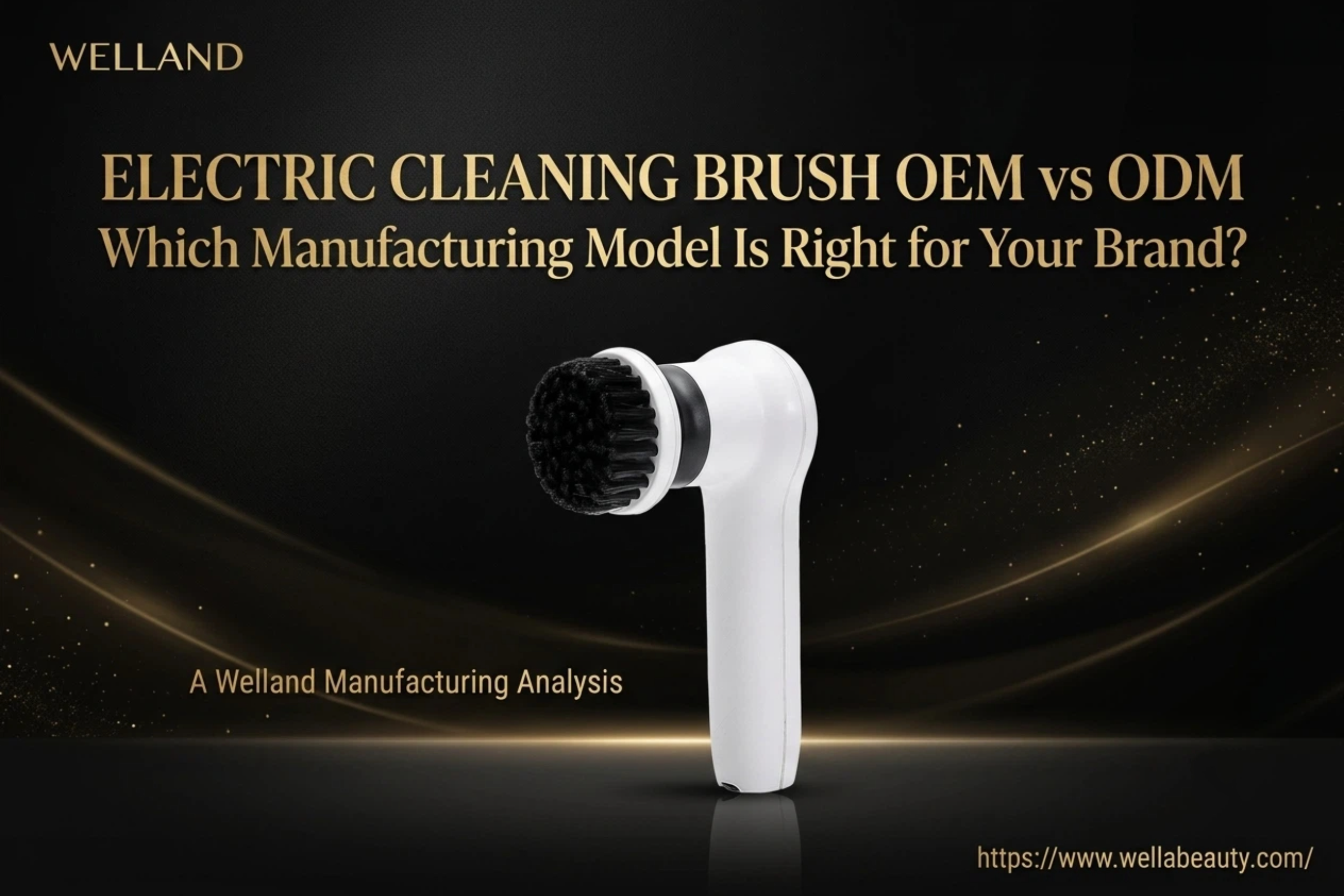
If you’re sourcing an electric cleaning brush for your brand, one of the first questions every B2B buyer faces is this: OEM or ODM? The answer shapes your product quality, intellectual property ownership, mass production timeline, and total cost structure—sometimes by a margin that determines whether your launch succeeds or stalls.
This guide cuts through the confusion. We’ll explain the real differences between electric cleaning brush OEM and ODM services, compare costs, timelines, IP implications, and help you match the right model to your brand’s goals.
OEM (Original Equipment Manufacturer) means you own the design. You bring your specifications, CAD drawings, or product brief to a factory, and they manufacture to your exact requirements. Every detail—motor type, brush head geometry, housing material, ergonomics, color scheme—is defined by your team in collaboration with the factory’s engineering team.
With OEM custom electric cleaning brush manufacturing, you retain full intellectual property rights. The product design belongs to you, and the factory cannot sell the same product to another buyer.
OEM is typically chosen by brands that:
ODM (Original Design Manufacturer) means the factory already has a proven product design. You select from their existing lineup—often battle-tested models with established supply chains—and customize the branding, color, packaging, and sometimes minor features. The underlying engineering and tooling belong to the factory.
ODM ready electric cleaning brush services are ideal for brands that:
| Factor | OEM | ODM |
|---|---|---|
| Design Ownership | Brand owns the IP | Factory owns the IP |
| Customization Depth | Full — from motor to housing | Partial — branding & color mainly |
| Upfront Cost (Tooling) | Higher ($3,000–$15,000+ molds) | Low or zero (existing molds) |
| OEM ODM Cost Electric Cleaning Brush (Unit) | Varies by spec; scales well at volume | Generally lower per unit at small MOQ |
| Time to Market | 90–150 days (including product development) | 30–60 days |
| MOQ | 2,000–5,000 units typical | 500–3,000 units typical |
| Product Exclusivity | High — design is yours alone | Low — other brands may use same base |
| Supply Chain Risk | More variables to manage | Streamlined, proven supply chain |
| Best For | Long-term brand building | Fast market entry & testing |
When evaluating intellectual property OEM vs ODM, the stakes are high. With OEM, your design files, molds, and engineering specifications are your property. You can register design patents and prevent competitors—including the factory itself—from copying your product.
With ODM, the factory owns the base design. They may white-label the same product to dozens of other buyers. This is not inherently bad—many successful brands launch on ODM foundations—but it limits your long-term defensibility.
Best practice: Always sign a mutual NDA before sharing design briefs. Whether OEM or ODM, work with manufacturers who have documented IP protection policies and transparent contractual terms.
Understanding the product development stages helps set realistic expectations for your timeline and budget.
Cost is always a top concern. Here’s a realistic breakdown of where your budget goes under each model:
| Cost Component | OEM | ODM |
|---|---|---|
| Tooling / Mold | $3,000–$15,000 (one-time) | $0 (existing molds) |
| Unit Cost at 1,000 MOQ | Varies widely by spec | Typically 10–20% lower |
| Certification | Shared or new (CE, FCC, RoHS) | Often already certified |
| Sampling | $200–$800 per round | $50–$300 (modified sample) |
| Packaging Design | Custom (brand investment) | Custom (brand investment) |
| Total Upfront Investment | Higher | Lower |
Pro tip: OEM’s higher upfront cost is offset by IP exclusivity and stronger margins over time. ODM’s lower entry cost makes it the smart choice for market validation before scaling to a custom design.
There is no universal answer to which is better OEM or ODM electric brush—it depends on your brand stage, budget, and strategic goals.
Many brands start with ODM electric cleaning brush services to test market demand, gather customer feedback, and generate initial revenue—then transition to OEM custom electric cleaning brush development for their second-generation product. This approach minimizes early-stage risk while building toward a defensible, unique product line.
Understanding the depth of electric cleaning brush customization OEM versus ODM is critical for setting buyer expectations.
| Customization Element | OEM | ODM |
|---|---|---|
| Motor type & RPM | ✔ Full control | ✘ Fixed |
| Brush head design & material | ✔ Custom | △ Limited options |
| Housing shape & ergonomics | ✔ Custom mold | ✘ Fixed mold |
| Color & surface finish | ✔ Full PMS color | ✔ Available options |
| Battery capacity | ✔ Specify | ✘ Fixed |
| Waterproof rating | ✔ Specify (IPX4–IPX7) | ✘ Fixed |
| Logo & branding | ✔ Yes | ✔ Yes |
| Packaging | ✔ Full custom | ✔ Full custom |
| Certifications | Apply for new or transfer | Often pre-certified |
Regardless of whether you choose OEM or ODM, product quality must be non-negotiable. A reliable manufacturer should operate multi-stage quality control across the entire supply chain:
For OEM and ODM projects alike, always request a factory’s quality documentation, certifications (CE, ROHS, FCC, ISO 9001), and pre-shipment inspection reports before committing to mass production.
When evaluating your manufacturer, verify:
What is the main difference between OEM and ODM for electric cleaning brushes?
OEM means you own the product design and the factory manufactures to your specifications. ODM means the factory provides an existing design that you brand as your own. OEM offers more IP control; ODM offers faster time-to-market.
Is OEM or ODM more expensive for electric cleaning brushes?
OEM has higher upfront costs due to tooling and product development (molds can run $3,000–$15,000+). ODM is lower risk and lower cost initially, though long-term margin potential is higher with OEM.
Who owns the intellectual property in OEM vs ODM?
In OEM, the brand owns the design IP. In ODM, the factory retains ownership of the core product design. Branding elements (logo, packaging) always belong to the brand in both models.
Can I patent an electric cleaning brush if I use ODM?
You can patent your brand’s unique branding, packaging, or any added proprietary features—but not the base product design owned by the factory. OEM gives you full patentable design rights.
What is the typical MOQ for electric cleaning brush OEM vs ODM?
OEM typically requires 2,000–5,000 units per SKU due to tooling investment. ODM often starts at 500–3,000 units since existing molds are used.
How long does OEM vs ODM production take?
ODM projects can be completed in 30–60 days. OEM projects typically take 90–150 days due to engineering review, tooling, prototyping, and revision cycles.
Can I switch from ODM to OEM later?
Yes—and this is a recommended strategy. Many brands validate their market with ODM, then invest in OEM for a differentiated second-generation product once demand is confirmed.
Do ODM electric cleaning brushes come pre-certified?
Often yes. Established ODM manufacturers typically hold CE, ROHS, FCC, and other certifications on their existing product lines. Always verify with the factory before assuming coverage applies to your branded version.
How do I protect my brand’s design in OEM manufacturing?
Sign a mutual NDA before sharing designs. Register your design in the target market (e.g., via CNIPA in China, or EPO in Europe). Work only with factories that have documented IP protection policies and clear contract terms.
What certifications do I need for an electric cleaning brush in the US and EU?
For the US: FCC certification and, depending on claims, FDA registration. For the EU: CE marking (covering LVD, EMC, RoHS), REACH compliance, and WEEE registration. Both markets recommend IPX6 or IPX7 waterproof certification for cleaning brushes used in wet environments.
Welland Manufacturing
Whether you need a fully custom OEM design or a fast-to-market ODM solution, Welland provides end-to-end support — from product development and engineering to mass production and global shipping.




 EN
EN  RU
RU  PT
PT  FR
FR  ES
ES  KO
KO  JA
JA  DE
DE  ZH
ZH