




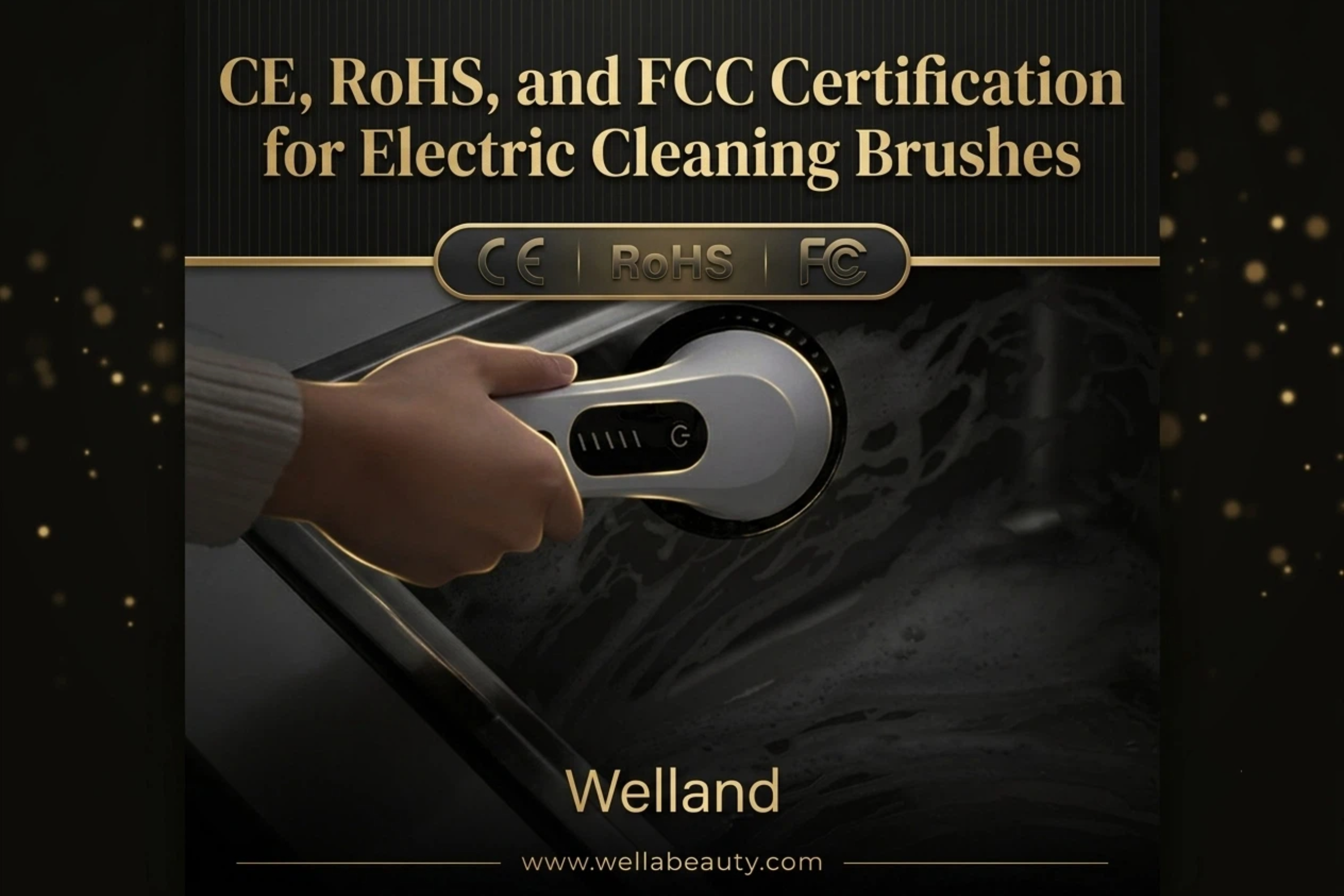
You have found the perfect electric cleaning brush manufacturer. The product samples look great, the MOQ fits your budget, and the price is competitive. Then the freight forwarder asks: “Does it have CE, RoHS, and FCC?”
If you are not sure what to say, you are not alone. Many B2B buyers — retailers, Amazon sellers, hospitality procurement teams, and OEM brand owners — treat these certifications as checkboxes without fully understanding what they protect against or what happens when a shipment arrives without them.
This guide covers CE mark compliance, RoHS certification, and FCC certification for electric cleaning brushes and similar personal care or household power tools. Whether you are importing into the EU, the US, or both, knowing the difference between these standards will save you from customs holds, product recalls, and marketplace delistings.
What Are CE, RoHS, and FCC Certifications?
These three certifications operate in different regulatory jurisdictions and cover different aspects of product safety. They are often grouped together because most export-grade electric cleaning brushes must hold all three to be legally sold across major markets.
| Certification | Jurisdiction | What It Covers | Mandatory? |
|---|---|---|---|
| CE Mark | EU + European Economic Area | Electrical safety, EMC, product directives | Yes, for EU market entry |
| RoHS | EU (often paired with CE) | Restriction of hazardous substances in materials | Yes, for EU EEE products |
| FCC | United States | Electromagnetic compatibility and radio frequency | Yes, for US market entry |
Each certification answers a different question. CE asks: Is this product safe to use in Europe? RoHS asks: Does this product contain banned toxic substances? FCC asks: Does this product generate electromagnetic interference that would disrupt US communications infrastructure?
CE Certification for Electric Cleaning Brushes
CE stands for Conformité Européenne, French for “European Conformity.” The CE mark is a mandatory requirement for products entering the European Economic Area (EEA), which includes all 27 EU member states plus Iceland, Liechtenstein, and Norway.
For electric cleaning brushes — which are powered tools that generate electromagnetic emissions — CE certification typically requires compliance with three core directives:
- Low Voltage Directive (LVD, 2014/35/EU) — Ensures electrical safety for products operating between 50–1000V AC or 75–1500V DC. Even USB-charged brushes may fall under this depending on the charging circuit.
- Electromagnetic Compatibility Directive (EMC, 2014/30/EU) — Ensures the motor and electronics do not emit interference that disrupts other devices, and that the product itself is immune to environmental interference.
- Radio Equipment Directive (RED, 2014/53/EU) — Required if the brush has Bluetooth connectivity, a wireless charging receiver, or any radio frequency component.
CE certification is manufacturer self-declaration for many product categories, meaning the manufacturer declares conformity and affixes the CE mark. However, they must have technical documentation, test reports, and a Declaration of Conformity (DoC) to support this. For any electric product, independent laboratory testing through an accredited EU Notified Body is standard practice for export-grade manufacturing.
Key point for importers: Always request the Declaration of Conformity (DoC) and the CE test report — not just the CE mark on the packaging. The mark alone is not proof of compliance. A reputable OEM supplier will provide these documents as a matter of course.
CE Certification Cost for Electric Cleaning Brushes
Testing costs for CE certification on electric cleaning brushes typically range from USD $800 to $2,500 depending on the directives involved and the testing laboratory. LVD and EMC testing together for a simple corded or battery-powered brush generally falls in the $1,000–$1,800 range. Adding RED testing for Bluetooth-enabled models adds $400–$800. These are one-time per-model costs that amortize quickly across production runs.
RoHS Certification: Hazardous Substances Compliance
RoHS — Restriction of Hazardous Substances — is an EU directive (2011/65/EU, updated as RoHS 2.0) that restricts the use of specific hazardous substances in electrical and electronic equipment (EEE). It works alongside CE certification and is effectively a prerequisite for any electric cleaning brush sold into the EU.
What Substances Does RoHS Restrict?
RoHS 2.0 restricts ten substances. The six original restricted substances are:
- Lead (Pb) — limit <0.1%
- Mercury (Hg) — limit <0.1%
- Cadmium (Cd) — limit <0.01% (strictest limit)
- Hexavalent chromium (Cr VI) — limit <0.1%
- Polybrominated biphenyls (PBB) — limit <0.1%
- Polybrominated diphenyl ethers (PBDE) — limit <0.1%
Four additional phthalates were added under RoHS 2.0:
- DEHP, BBP, DBP, and DIBP — each at <0.1%
These substances are commonly found in solder, wire insulation, circuit boards, plastic housings, coatings, and battery components — all materials present in electric cleaning brushes. RoHS compliance requires chemical testing of each homogeneous material in the product, not the finished product as a whole.
RoHS and CE: How They Work Together
RoHS compliance is a prerequisite for CE marking for most electronic products. When your supplier provides CE documentation, confirm it references the RoHS Directive explicitly. A separate RoHS test report from an accredited laboratory (such as SGS, Bureau Veritas, or TÜV) provides additional assurance for importers and retail buyers who may require it independently.
FCC Certification for Electric Cleaning Brushes
FCC certification is administered by the US Federal Communications Commission and is required for any electronic product that generates radio frequency energy at or above 9 kHz that is sold or imported into the United States. Electric cleaning brushes — even simple ones with DC motors — fall within scope because motors and switching power supplies inherently generate electromagnetic emissions.
FCC SDoC vs. FCC ID: Which Does Your Brush Need?
| Pathway | Applies To | Process |
|---|---|---|
| FCC SDoC | Non-wireless: standard corded or battery-powered cleaning brushes | Manufacturer self-declares after lab testing; no FCC ID required |
| FCC ID Certification | Intentional radiators: Bluetooth-enabled brushes, wireless charging models | Must be reviewed by an FCC-recognized TCB; assigned a unique FCC ID number |
Most standard electric cleaning brushes — spin scrubbers, bathroom cleaning brushes, facial cleansing brushes without wireless features — qualify for the SDoC pathway. Models with Bluetooth app connectivity or wireless charging require full FCC ID certification.
After certification, the FCC compliance information must be marked on the product or its packaging. Products that arrive without this marking may be detained by US Customs or rejected by marketplace platforms including Amazon and Walmart.
FCC Certification Cost for Electric Cleaning Brushes
FCC SDoC testing for a standard electric cleaning brush typically costs USD $400 to $900 through an accredited laboratory. FCC ID certification for Bluetooth-enabled models ranges from $800 to $2,000 depending on the frequency bands and test complexity. These are per-model, one-time costs.
Why These Certifications Matter for B2B Importers
1. Customs Clearance and Border Control
Products entering the EU without a valid CE mark can be seized at the border, returned to the exporter at the importer’s cost, or destroyed. In the US, uncertified products emitting radio frequency interference can be denied entry by US Customs or subject to FCC enforcement action after reaching the market. These are not theoretical risks — they happen to importers who rely on unverified supplier claims.
2. Marketplace Eligibility
Amazon, Walmart, Target, and major EU e-commerce platforms all require CE and RoHS documentation for electric products as part of their seller compliance programs. An account suspension due to missing certification documentation can be far more costly than the certification itself.
3. Liability and Brand Protection
If a non-compliant electric cleaning brush causes a fire or injury, the importer — not the overseas manufacturer — typically bears legal liability in the destination country. Certification is your first line of protection. For OEM and private-label brands, it is also a fundamental part of brand credibility.
4. Retailer and Wholesale Buyer Requirements
Large retailers and B2B buyers increasingly require certification documentation as part of vendor qualification. CE RoHS certification, alongside an ISO-certified quality management system, is a standard expectation for professional procurement teams in Europe, North America, and the Gulf markets.
What to Ask Your Electric Cleaning Brush Supplier
When evaluating OEM suppliers for electric cleaning brushes, go beyond asking “Are you certified?” Ask for specific documentation:
- CE Declaration of Conformity (DoC) — Must identify the specific directives (LVD, EMC, RED) and reference the product model.
- CE Test Report — From an accredited laboratory. Check the lab’s name, the test date, and the product specification tested.
- RoHS Test Report — Material-level chemical analysis from an accredited third party (SGS, Bureau Veritas, Intertek, TÜV).
- FCC Test Report and SDoC or FCC ID — For US market sales. Confirm the FCC ID is registered in the FCC database if applicable.
- ISO 9001 Certificate — Indicates the factory operates a documented quality management system, reducing the risk of production batches that differ from certified samples.
Red flag: A supplier who says “we have CE” but cannot provide the actual DoC and test report may be using a CE mark without valid testing behind it. This transfers the compliance risk entirely to you as the importer.
CE RoHS and FCC Certification: Typical Timelines
| Certification | Typical Lead Time | Notes |
|---|---|---|
| CE (LVD + EMC) | 3–6 weeks | From sample submission to test report |
| RoHS Material Testing | 2–4 weeks | Requires disassembly and chemical analysis |
| FCC SDoC | 2–4 weeks | Can run in parallel with CE testing |
| FCC ID (wireless models) | 6–10 weeks | Requires TCB review after lab testing |
| UKCA (UK market) | 4–8 weeks | Separate process from CE since 2023 |
Working with an established OEM partner who holds existing certifications on their product platforms significantly shortens these timelines, since core test data can often be reused across model variants.
Source Certified Electric Cleaning Brushes from Welland
Welland electric cleaning brushes carry CE, RoHS, FCC, and additional certifications as standard. Our factory is ISO 9001 and ISO 14001 certified, with BSCI audit compliance. Request your OEM/ODM quote and receive full certification documentation with your samples.
Frequently Asked Questions
Is CE certification mandatory for electric cleaning brushes sold in the EU?
Yes. Any electric cleaning brush sold within the European Economic Area must carry the CE mark. This applies to battery-powered, USB-rechargeable, and mains-powered models. Selling without a valid CE mark can result in product withdrawal, fines, and import bans.
What is the difference between CE and RoHS for electric cleaning brushes?
CE certification covers product safety across multiple directives (electrical safety, EMC, radio equipment). RoHS is a specific EU directive restricting hazardous substances — lead, mercury, cadmium, chromium, and several phthalates — in the materials used to manufacture the product. Most electric cleaning brushes require both.
Do I need FCC certification if I am only selling in the EU?
No. FCC certification is a US Federal Communications Commission requirement and is only mandatory for products sold or imported into the United States. If your target markets are exclusively EU countries, CE and RoHS are your primary requirements. However, many OEM suppliers obtain FCC alongside CE as a standard package for export-grade products.
How much does CE certification cost for an electric cleaning brush?
Combined CE LVD and EMC testing typically costs between USD $800 and $2,500 per product model. For Bluetooth-enabled brushes, adding RED testing increases costs by $400–$800. These are one-time certification costs per model that a qualified OEM supplier will typically have already completed for their standard product lines.
What documents should I request from my OEM supplier as proof of CE certification?
Request the CE Declaration of Conformity (DoC), the full CE test report from an accredited laboratory, and the RoHS test report. The DoC must name the specific directives the product complies with and be signed by an authorized representative of the manufacturer.
My electric cleaning brush has Bluetooth connectivity — does it need FCC ID certification?
Yes. Any device that intentionally transmits radio frequency energy — including Bluetooth — requires FCC ID certification. This requires review by an FCC-recognized Telecommunication Certification Body (TCB) and results in the product being assigned a unique FCC ID number that must be displayed on the product.
Can I use CE-certified products from China directly without additional testing?
In principle, yes — if the CE certification is valid, documented, and the product in production is identical to the tested sample. In practice, always request the original DoC and test reports, verify the testing laboratory is accredited, and consider requesting a production batch sample test for high-volume SKUs. The importer bears liability in the EU market.
What does RoHS compliance mean for the supply chain?
RoHS compliance extends through the entire supply chain. Your OEM manufacturer must ensure that every component and material used in production meets the restricted substance limits. This means collecting material declarations from their own sub-suppliers and conducting chemical testing on homogeneous materials. Ask whether your supplier maintains an active RoHS-compliant material management system.
Does the UKCA mark replace CE for the UK market?
Yes. The UKCA mark is now mandatory for products sold in Great Britain following Brexit. As of 2023, CE marking alone is no longer accepted in Great Britain for most product categories. If you are selling into the UK, confirm your supplier can provide UKCA documentation in addition to CE.
How do I verify that a supplier’s CE certification is genuine?
Request the full Declaration of Conformity and cross-reference the testing laboratory name with the EU database of accredited Notified Bodies (NANDO). Check that the product description on the DoC matches the product you are buying, that the directives listed are appropriate for the product type, and that the document is dated within a reasonable period. If in doubt, commission an independent verification test from a reputable laboratory.
Related Resources
Ready to Start Your OEM Order?
Welland supplies CE, RoHS, and FCC certified electric cleaning brushes to distributors, retail brands, and private-label importers globally. MOQ from 3,000 units. Full certification package included.
 EN
EN  RU
RU  PT
PT  FR
FR  ES
ES  KO
KO  JA
JA  DE
DE  ZH
ZH