

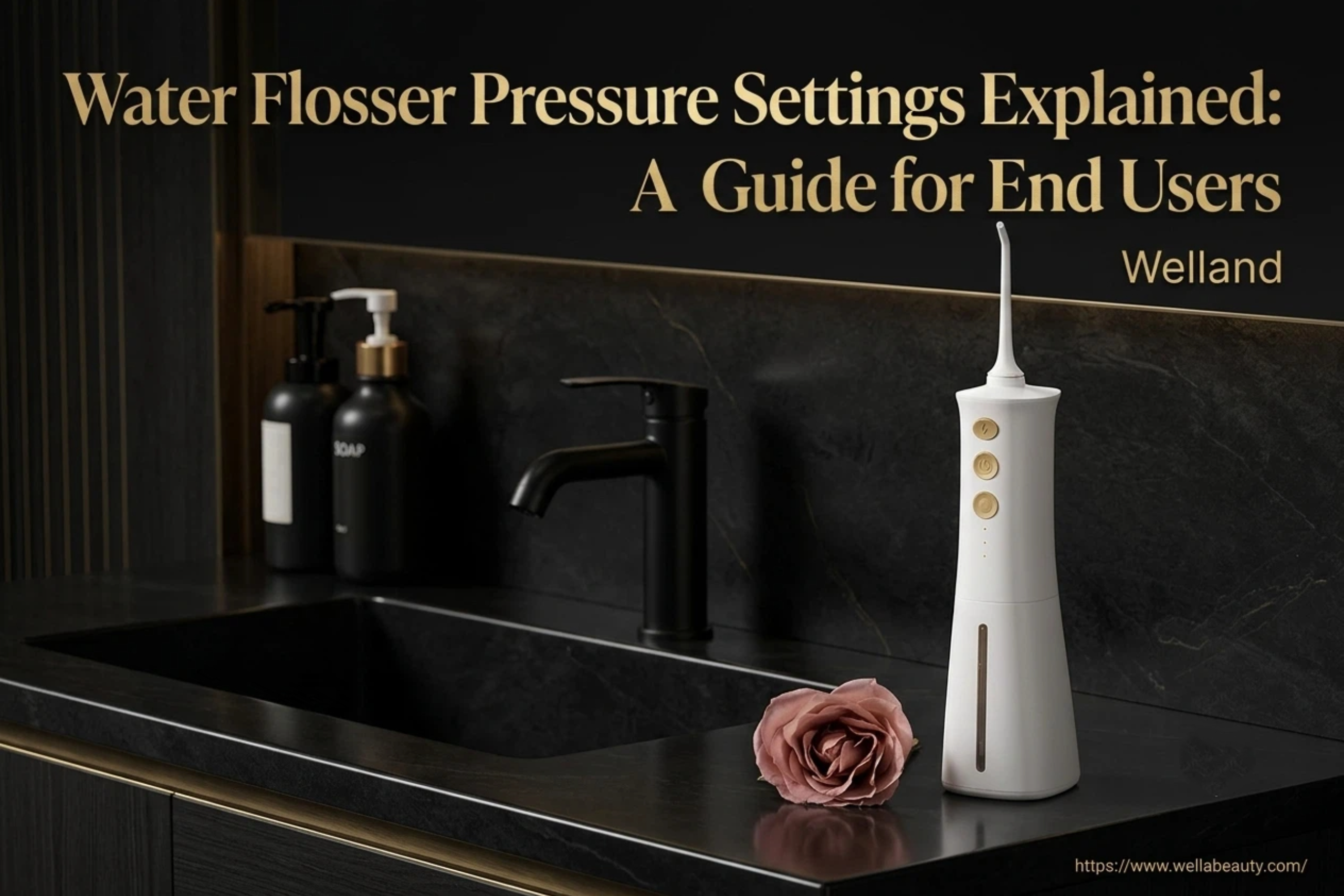
If you’re sourcing water flossers for retail distribution, private labeling, or OEM development, understanding water flosser pressure settings is one of the most critical specification decisions you’ll make. Pressure determines cleaning efficacy, user comfort, product positioning, and ultimately, end-customer satisfaction.
This guide breaks down everything from water flosser PSI settings and pressure ranges to soft mode options and clinical applications—so your procurement team can make confident, data-backed decisions.
Water flosser pressure settings control the force at which a pulsating stream of water is delivered through the oral irrigator tip. Measured in PSI (pounds per square inch), water pressure determines how effectively the device removes food particles, disrupts plaque biofilm, and flushes bacteria from gum pockets.
Most consumer-grade adjustable pressure water flossers operate in a range of 10 to 100 PSI. The number of selectable pressure levels varies by model: entry-level units may offer 2–3 settings, while premium countertop models provide up to 10 discrete pressure steps. For B2B buyers, this range flexibility is a key differentiator when matching product lines to specific consumer segments.
Understanding the distinction between low pressure water flosser modes and high-pressure dental rinse modes is essential—because the same device may need to serve different user profiles across your distribution network.
The low end of the pressure spectrum is designed for:
A water flosser soft mode at this PSI range allows the oral irrigator to gently flush debris without causing discomfort or aggravating inflamed tissue. Dental professionals often recommend starting at the lowest pressure setting before gradually increasing, which is why multi-setting models are clinically preferred over fixed-pressure devices.
From a sourcing standpoint, units with a reliable low-pressure entry point reduce post-sale complaints and returns—making this spec critical for mass-market retail SKUs.
The mid-range is the everyday workhorse setting for most adult users with generally healthy gum tissue. At this level, water flossing effectively:
Most B2B buyers will find that the majority of their end-customers settle into the 40–60 PSI range for regular dental flossing routines. When filling the reservoir with warm water at this pressure, users typically achieve a comfortable, effective clean without requiring instruction.
High-end pressure settings are the primary selling point for users with complex oral care needs:
Countertop oral irrigator models rated at 90–100 PSI are commonly recommended for orthodontic cleaning use cases. If your product line targets orthodontic or dental implant users, sourcing models with high-PSI ceiling and tip compatibility is non-negotiable.
The answer depends on your target market segment. Here’s a practical sourcing framework:
| Pressure Settings | PSI Range | Best For | Positioning |
|---|---|---|---|
| 2–3 Settings | 45–75 PSI | Cordless / travel units | Entry-level, value retail |
| 5–6 Settings | 10–90 PSI | Mid-range countertop | Mass market / family use |
| 10 Settings | 10–100 PSI | Premium countertop / ION-class | Premium, clinical-adjacent |
For OEM and private label development, 10-setting adjustable pressure water flosser models offer maximum end-user flexibility and command a higher shelf price. For value retail or promotional SKUs, a 3-setting cordless unit with a proven low pressure start point remains highly competitive.
Users with bleeding gums, gum recession, or early-stage periodontal disease represent one of the fastest-growing water flosser user segments. For this group, the ability to start low pressure water flosser and gradually increase is not a convenience—it’s a clinical requirement.
A dental professional recommending an oral irrigator to a patient with sensitive gum tissue will specifically look for units that offer a genuinely low PSI entry point (10–20 PSI) and smooth pressure graduation. Products that jump from 30 PSI to 80 PSI in two steps do not serve this segment well.
Using warm water in the reservoir also significantly reduces sensitivity at any pressure level—a usage tip that should be prominently featured in your product packaging and instruction materials.
Water flossing is now widely recommended by orthodontists as an adjunct to brushing during active treatment. The combination of an orthodontic water flosser tip and mid-to-high pressure (50–80 PSI) creates a cleaning action that string dental flossing cannot replicate around brackets and wires.
Key product specs for the orthodontic segment include:
Post-restorative dental care requires precise tip placement at lower-to-mid pressure settings. The pik pocket tip used at the lowest pressure setting is specifically designed to deliver water or antimicrobial rinse into periodontal pockets without damaging tissue or implant margins.
Products targeting dental implant users should be positioned with a clinical credibility narrative—emphasizing low-pressure soft mode capability and tip versatility over raw PSI numbers.
For general-use family oral care, the priority is ease of use, multi-user tip system (color-coded rings for family identification), reliable water pressure across the mid-range, and a large enough reservoir to allow adequate flossing time without multiple refills.
Countertop models with 35 oz reservoir capacity and 6–10 pressure settings offer the best value proposition for this segment. Filling the reservoir with warm water at setting 4–6 on a 10-point scale is the typical starting point most users will settle into.
One of the most common B2B sourcing questions involves the trade-offs between cordless and countertop oral irrigator models in terms of pressure delivery:
A well-structured product portfolio will carry both form factors, allowing your retail partners to merchandise across price points while maintaining brand consistency.
Including clear pressure guidance in your product documentation reduces returns and increases user satisfaction. Here’s the standard protocol that dental professionals recommend:
Water flosser pressure settings work in combination with tip type to determine actual cleaning efficacy. Here’s a quick reference for B2B product documentation and training materials:
| Tip Type | Recommended Pressure | Primary Use | Replace Every |
|---|---|---|---|
| Precision / Classic Tip | Medium–High (40–100 PSI) | General daily oral care, remove plaque | 6 months |
| Orthodontic Tip | Medium (40–70 PSI) | Braces, aligners, orthodontic work | 3 months |
| Pik Pocket Tip | Low only (10–20 PSI) | Periodontal pockets, post-surgical | 3 months |
| Plaque Seeker Tip | Low–Medium (20–50 PSI) | Implants, crowns, bridges, veneers | 3 months |
| Tongue Cleaner | Low (10–30 PSI) | Bacteria removal, fresh breath | 6 months |
For OEM and private label buyers, offering a multi-tip bundle pack significantly increases average order value and positions the product as a comprehensive oral irrigator system rather than a single-use device.
When evaluating adjustable pressure water flosser models for your product portfolio, use this specification checklist:
WELLAND has been developing premium oral care appliances for global B2B partners since our founding. Our adjustable pressure water flosser line is engineered with the full pressure spectrum in mind—from a genuine 10 PSI low-pressure soft mode to a full-power 100 PSI deep-clean setting—giving your end-customers the clinical flexibility that dental professionals recommend.
Our product development team works directly with OEM and private label partners to configure pressure settings, tip compatibility, reservoir capacity, and exterior design to match your brand positioning and target consumer segment. Whether you’re sourcing for pharmacy retail, e-commerce, dental supply, or hotel amenity channels, WELLAND’s manufacturing capabilities and quality systems are built to scale with your requirements.
B2B & OEM SOURCING
WELLAND’s engineering team will help you match water flosser PSI settings, tip configurations, and reservoir specs to your exact product requirements. Request a catalog or sample today.
Always start low pressure water flosser at the lowest available PSI setting—typically 10–20 PSI—regardless of whether you’re new to water flossing or switching to a new device. This allows gum tissue to acclimate to the pulsating water pressure before you increase to your preferred level. Most users find their comfortable everyday setting after 1–2 weeks of use.
For users with sensitive gums, gum recession, or active gum disease, a water flosser pressure for sensitive gums should remain in the 10–30 PSI range. Combining low pressure with warm water in the reservoir significantly reduces discomfort. If sensitivity persists, consult a dental professional before increasing water pressure.
Yes, but with the correct tip. Water flosser pressure for braces is most effective at mid-to-high settings (50–80 PSI) when paired with an orthodontic or tapered brush tip. The higher pressure helps dislodge food particles from around brackets and wires. Always start at a lower setting and increase gradually to avoid bracket sensitivity.
A minimum of 3 pressure settings is considered adequate for general use. For clinical-adjacent applications (sensitive gums, periodontal care, orthodontics), 10-step pressure graduation offers significantly more user control. From a B2B perspective, 10-setting models command higher price points and lower return rates.
Warm water is strongly preferred, particularly for users with sensitivity. Using warm water when filling the reservoir helps relax gum tissue and reduces the shock of the water pressure, making the experience more comfortable at any PSI level.
Water flosser soft mode is a manufacturer term for the lowest pressure setting or a dedicated low-PSI mode designed for gentle cleaning. It is equivalent to operating the device at 10–25 PSI and is the recommended starting point for new users, those with sensitive gums, or anyone using specialty tips such as the pik pocket tip for periodontal pocket treatment.
Excessive pressure on already-inflamed or recession-affected gum tissue can cause temporary discomfort and, in rare cases, worsen irritation. This is why graduated pressure settings and the recommendation to start at low pressure are clinically important. At appropriate settings, water flossing is considered safe and gentle compared to aggressive string dental flossing technique.
Generally, no. Cordless water flossers typically deliver 45–75 PSI across 2–3 pressure settings due to motor size constraints. Countertop oral irrigator models deliver the full 10–100 PSI range with up to 10 settings. For users requiring the full pressure spectrum—particularly low-pressure soft mode or maximum-pressure deep cleaning—a countertop adjustable pressure water flosser is the recommended choice.
Your PSI specification should be driven by your target end-user segment. Sensitive gum and family-use positioning requires a genuine low-pressure entry point (10–20 PSI). Orthodontic and premium positioning benefits from a 10–100 PSI range with 10 discrete settings. WELLAND’s product team can guide specification decisions based on your distribution channel and price point requirements. Contact our OEM team for a consultation.
You can add a small amount of mouthwash to the reservoir—no more than a 1:1 ratio of water to mouthwash—to enhance the antimicrobial effect of water flossing. However, always rinse the reservoir and run plain warm water through the unit and tip into the sink after use to prevent residue buildup. Standard or antiseptic mouthwash formulations are compatible; avoid oil-based rinses.
Existing WELLAND Blog Posts:
WELLAND B2B PARTNERSHIP
Looking for a manufacturing partner who understands how pressure settings drive product positioning? WELLAND offers full OEM/ODM capabilities—from PSI specification to packaging design.




 EN
EN  RU
RU  PT
PT  FR
FR  ES
ES  KO
KO  JA
JA  DE
DE  ZH
ZH