

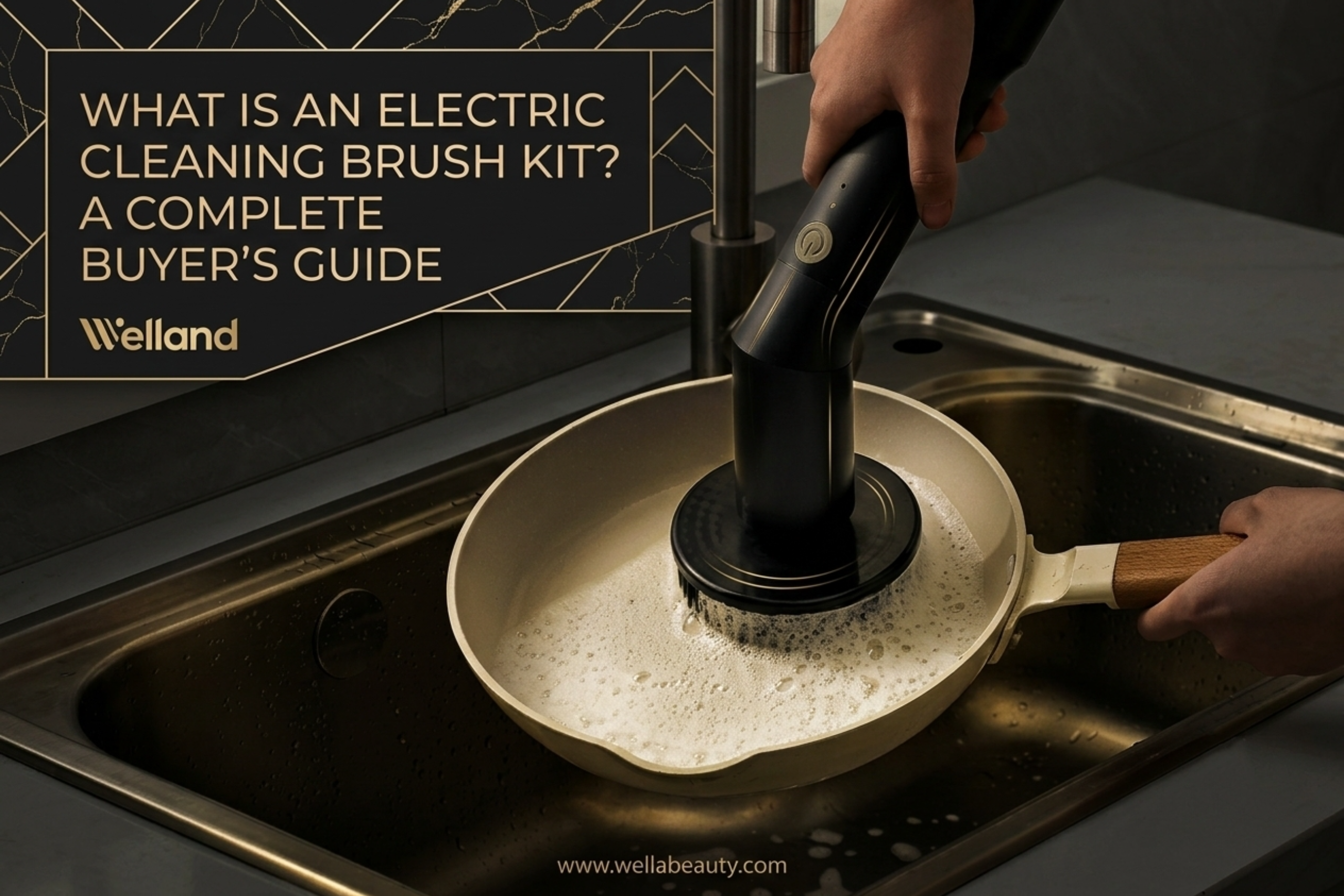
If you’ve ever spent an afternoon on your knees scrubbing bathroom grout or battling soap scum on shower walls, you already understand the market problem that the electric cleaning brush kit was built to solve. For B2B buyers—retail chains, private-label brands, supermarket buyers, and cross-border e-commerce operators—understanding exactly what this product category is, how it works, and what separates a premium kit from a commodity one is the foundation of smart procurement.
This complete buyer’s guide answers every essential question: what an electric cleaning brush kit is, how electric spin scrubbers and power scrubbers differ, which features drive sell-through on shelves, and why WELLAND is the OEM/ODM partner of choice for brands sourcing these products at scale.
An electric cleaning brush kit is a motorized cleaning system comprising two core components: a rechargeable power handle and a set of interchangeable brush heads. The handle contains a high-speed electric motor—typically operating between 250 and 400 RPM for household models—that drives the attached brush head in a rotating or oscillating motion. This mechanical action replaces the physical effort of manual scrubbing, making it significantly faster and less fatiguing for the end user.
The “kit” element is what elevates these products above single-purpose scrubbers. A well-configured kit equips one device with the versatility to clean across the entire home: bathroom tiles, grout lines, shower walls, bathtubs, kitchen stovetops, sinks, and even floor surfaces. Premium kits also include an extendable handle or telescoping rod, allowing users—including elderly users and those with limited mobility—to reach floors, ceiling corners, and high tiles without bending or stretching.
In short: An electric cleaning brush kit is a complete, all-in-one scrubber tool system designed to replace multiple single-purpose cleaning products with one rechargeable, multi-surface solution.
The core mechanism of any electric spin scrubber is straightforward. A rechargeable lithium-ion battery—typically 1200 mAh to 2600 mAh—powers a brushless or brush motor inside the handle. When the user presses the power button, the motor drives the head attachment in continuous rotation (spin scrubbers) or rapid back-and-forth oscillation (oscillating scrubbers).
This rotational force does the work. Instead of the user applying manual pressure in repeated circular motions, the spinning brush head agitates grime, soap scum, mineral deposits, and mold at the surface level. The mechanical agitation loosens stuck-on debris, which is then removed with rinsing or wiping. The result is a cleaning outcome that would take 20–30 minutes of manual effort achieved in 3–5 minutes—a value proposition that resonates strongly with end consumers and drives category repeat purchases.
Advanced models incorporate variable speed settings, allowing users to select a lower RPM for delicate surfaces (glass, mirrors, finished wood) and a higher RPM for tough jobs like electric cleaning brush for grout applications or scale-covered bathroom tiles.
These two terms are frequently used interchangeably in the market, but there are meaningful distinctions that matter for product positioning:
| Feature | Electric Cleaning Brush Kit | Power Scrubber |
|---|---|---|
| Primary motion | Rotational spin | Oscillation or spin |
| Handle format | Handheld + optional extension rod | Often built-in long handle |
| Brush head variety | High (4–8 attachments) | Moderate (2–4 attachments) |
| Target user | All households; B2B retail kits | Households needing reach |
| Price positioning | Entry to premium ($15–$80) | Mid to premium ($30–$120) |
| OEM opportunity | High — kit packaging adds value | Moderate |
For most B2B retail and private-label applications, the electric cleaning brush kit format offers the strongest value story because the multi-head packaging communicates versatility at point of sale—a critical driver for impulse conversion in supermarket and home improvement retail environments.
One of the strongest selling points of a well-designed electric cleaning brush kit is its surface versatility. Here is how different configurations perform across common cleaning environments:
The bathroom kitchen cleaning segment is the core use case for this product category. A flat round brush head excels on bathroom wall tiles and shower doors, while a narrow pointed head penetrates grout lines to remove mold and discoloration. A sponge pad attachment handles mirrors and glass surfaces without scratching. In the kitchen, the same device tackles greasy stovetop surfaces, backsplash tiles, and sink basins.
The electric cleaning brush for shower and electric cleaning brush for bathtub applications benefit most from waterproofing (IPX5 or IPX7) and the ability to apply consistent pressure along curved surfaces. A brush head with medium-stiffness nylon bristles is the standard recommendation for fiberglass, porcelain, and acrylic tub surfaces.
When paired with an extendable handle, the same kit converts into an electric cleaning brush for floors, handling tile grout on floor surfaces—one of the most labor-intensive household cleaning tasks—in a fraction of the time required by traditional methods.
A telescoping or extendable rod transforms the unit into an electric scrubber for hard-to-reach areas: behind toilets, under appliances, high wall tiles, and window frames. This feature is especially valued for electric cleaning brush for elderly users who cannot safely bend, kneel, or stretch.
For buyers evaluating SKUs for retail placement or private-label development, these are the specification categories that drive both consumer satisfaction scores and shelf velocity:
Higher RPM delivers faster cleaning on tough surfaces. Look for a minimum of 300 RPM for general-purpose kits, and 400+ RPM for kits positioned as heavy-duty or professional-grade. Models featuring an electric spin scrubber LED display allow users to monitor speed settings and battery level—a premium feature that supports higher price-point positioning.
Battery life is the single biggest differentiator in consumer satisfaction, according to independent testing data. A rechargeable electric scrubber with a 2000 mAh+ battery and USB-C charging supports 60–90 minutes of continuous use—sufficient for a full home clean in one charge. Models with shorter battery life (under 30 minutes) consistently underperform in customer reviews, creating returns and negative sentiment that erode brand equity.
Any cordless electric scrubber designed for bathroom and kitchen use must carry at minimum an IPX5 rating (water jet resistant). IPX7 (submersible to 1 meter for 30 minutes) is the specification that justifies a premium price point and reduces warranty claim risk.
An electric cleaning brush with multiple heads positions the product as a complete solution rather than a single-purpose tool. For strong shelf appeal, a minimum of 4 heads is recommended: large flat, small flat, corner/grout, and sponge pad. Kits with 6–8 heads support higher retail price thresholds.
Handle weight under 500g is optimal for extended use. A non-slip grip, balanced weight distribution, and a single-button power interface reduce user fatigue—critical for the electric cleaning brush for elderly user segment, which represents a fast-growing demographic in mature markets.
An electric scrubber with extendable handle significantly expands the addressable use case. Products that clean floors without kneeling and high tiles without ladders convert at higher rates in aging-population markets (Japan, Germany, United States, South Korea).
For North American retail (CE, FCC, RoHS), European retail (CE, RoHS, PAH), and retail chain compliance (BSCI, ISO 9001), full certification documentation is non-negotiable. Always request test reports alongside product samples when evaluating new suppliers.
The phrase “electric scrubber no elbow grease” captures the emotional core of why this category is growing. Consumer research consistently shows that the primary barrier to cleaning high-effort surfaces—shower grout, bathtub rings, stovetop grime—is not motivation but physical fatigue and discomfort. An electric spin scrubber removes this barrier entirely.
For B2B buyers, this translates directly into a merchandise story: this is not a replacement for existing cleaning supplies. It is an upgrade that saves time, reduces physical strain, and delivers a visibly superior outcome. This narrative supports placement in premium cleaning sections, gift sets, and homeware bundles—all higher-margin retail formats than commodity cleaning consumables.
The electric cleaning brush for elderly segment deserves specific attention in procurement planning. In markets with aging populations, cleaning tools that eliminate the need to kneel, bend, or apply significant physical force are not a convenience—they are a functional necessity. Key product attributes for this segment include:
Retailers targeting this segment in pharmacy chains, homecare catalogs, and senior-focused retail channels report strong attach rates and high repeat purchase intent—a compelling category argument for buyers building age-in-place product assortments.
WELLAND (Wenzhou Welland Electric Co., Ltd.) has specialized in electric cleaning brushes, water flossers, and personal care devices since 2018, supplying domestic and international brand chains, cross-border e-commerce platforms, and private-label programs across multiple continents.
What sets WELLAND apart for B2B procurement:
| B2B & OEM Sourcing Ready to Source a Private-Label |




 EN
EN  RU
RU  PT
PT  FR
FR  ES
ES  KO
KO  JA
JA  DE
DE  ZH
ZH