



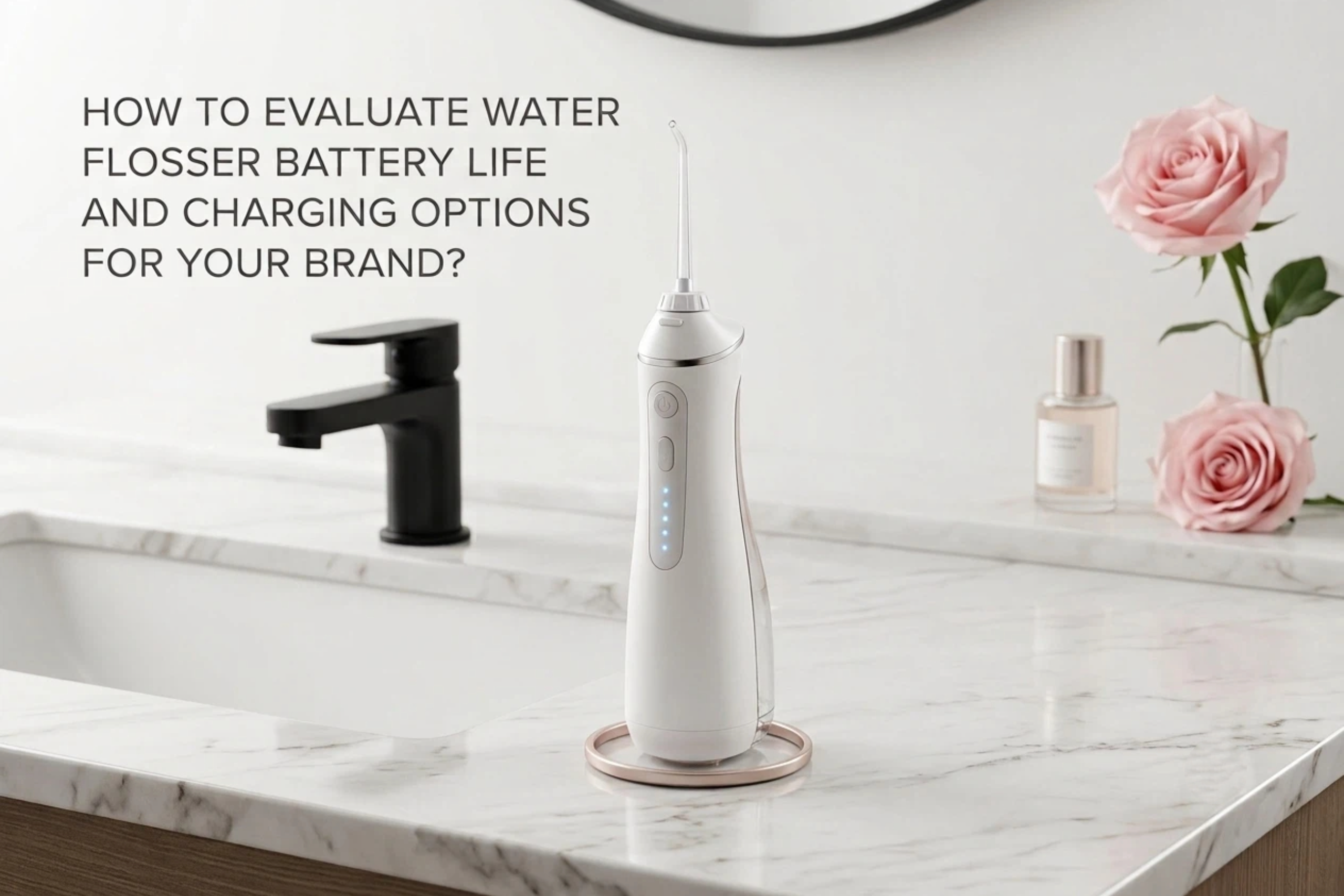
If you are sourcing cordless water flossers for private label, retail distribution, or OEM production, battery life and charging technology are two specifications that can make or break your product’s market performance. A device that dies mid-flossing session — or takes hours to recharge — generates negative reviews, drives return rates up, and erodes brand trust. Yet these metrics are often buried deep in supplier spec sheets, written in inconsistent formats, and rarely tested under real-world conditions.
This guide is built specifically for B2B buyers, procurement managers, and brand owners who need a professional evaluation framework — not a consumer review. We will walk through battery chemistry, capacity benchmarks, charging interface options, compliance requirements, and the testing protocols that separate a reliable supplier from a liability.
By the end, you will have a clear checklist for evaluating water flosser battery life and charging options before committing to an OEM or ODM order.
When B2B buyers evaluate a rechargeable water flosser, the focus typically lands on water pressure, tank capacity, and nozzle design. Battery specifications — capacity (mAh), chemistry, charging time, and cycle life — receive far less attention, despite being one of the top three drivers of customer satisfaction and return rates in the cordless oral care category.
Here is why this gap exists and why closing it matters:
Sourcing takeaway: Treat water flosser battery life as a primary evaluation criterion, not a secondary spec. The cost difference between a quality lithium battery and a budget alternative is typically $0.50–$1.50 per unit — a fraction of the return and reputation cost you absorb when battery performance falls short.
The two dominant battery chemistries in the cordless water flosser market are lithium-ion (Li-ion) and nickel-metal hydride (NiMH). Your choice of chemistry directly affects runtime, charging behavior, weight, lifespan, and regulatory compliance — and it should be driven by your target market and positioning, not just unit cost.
Li-ion batteries are the industry standard for premium and mid-range rechargeable water flossers. Their advantages for B2B sourcing are clear:
NiMH batteries appear primarily in entry-level and budget water flossers. Their trade-offs are significant:
Cost comparison: NiMH cells are $0.30–$0.80 cheaper per unit than Li-ion at equivalent capacity. However, when you factor in return rates, warranty costs, and review impact, Li-ion delivers a superior total cost of ownership for brands targeting the mid-range and premium market.
Sourcing recommendation: For any Welland’s cordless water flosser product range targeting retail, pharmacy, or e-commerce channels where reviews and repeat purchases drive revenue, specify Li-ion batteries in your OEM brief. Reserve NiMH only for ultra-budget SKUs or promotional giveaway programs where battery longevity is not a brand promise.
Battery capacity (measured in mAh) determines how long a cordless water flosser runs between charges. But the relationship between mAh and actual usage time is not linear — pressure setting, pump efficiency, and battery chemistry all affect the translation.
Here are the benchmarks we recommend for B2B sourcing decisions:
| Market Positioning | Recommended Capacity (Li-ion) | Expected Runtime | Target User Profile |
|---|---|---|---|
| Entry-level / promotional | 800–1000mAh | 3–5 days (once daily, 2 min) | Budget retail, gifting, trial purchase |
| Mid-range / lifestyle | 1200–1500mAh | 7–14 days (once daily, 2 min) | E-commerce DTC, pharmacy chains, travel |
| Premium / professional | 1800–2500mAh | 14–30 days (once daily, 2 min) | Dental supply, premium retail, hotel amenity |
| Ultra-premium / clinical | 2500mAh+ | 30+ days (once daily, 2 min) | Professional dental recommendation tier |
Key evaluation point: Always ask your supplier for tested runtime at the highest pressure setting, not the lowest. Consumer behavior data shows that 60–70% of users default to medium or high pressure — the setting that drains battery fastest. If your supplier only quotes runtime at low pressure, assume the real-world figure will be 30–40% shorter.
Welland’s standard OEM water flosser ships with a 1500mAh lithium battery — positioned in the mid-range benchmark that delivers 7–14 days of real-world use. This capacity has been validated through 100% in-line charging and performance testing at Welland’s factory, as part of the ISO 9001 quality management system.
The charging interface on a rechargeable water flosser affects three things: user convenience, manufacturing cost, and your product’s perceived modernity. For B2B sourcing, this decision has strategic implications beyond the spec sheet.
USB-C has become the dominant charging standard for portable water flossers in the 2024–2026 market cycle. Its advantages for brand owners are substantial:
Some legacy and countertop water flosser models still use proprietary magnetic charging bases or pin connectors. For B2B sourcing, the trade-offs are clear:
Sourcing recommendation: For any new cordless water flosser OEM project, specify USB-C charging unless you have a specific IPX8 waterproofing requirement that demands a magnetic dock. USB-C aligns with regulatory trends, reduces cost, and improves consumer satisfaction — three wins that proprietary ports cannot deliver simultaneously.
The charging time to usage time ratio is the single metric that most directly correlates with consumer satisfaction in the water flosser battery life category. It answers the user’s implicit question: “How long do I have to wait to use this again?”
Current market benchmarks for cordless water flosser charging time:
| Battery Capacity | Typical Charge Time (USB-C) | Typical Usage Time (High Pressure) | Ratio |
|---|---|---|---|
| 1000mAh | 1.5–2 hours | 15–20 minutes total | 1:0.13 (acceptable) |
| 1500mAh | 2–3 hours | 25–35 minutes total | 1:0.15 (good) |
| 2000mAh | 3–4 hours | 40–55 minutes total | 1:0.16 (excellent) |
What this means for sourcing: A 1500mAh Li-ion water flosser that charges in 2–3 hours via USB-C and delivers 25–35 minutes of high-pressure runtime provides approximately 7–14 days of once-daily, 2-minute sessions. This ratio (roughly 1:0.15) is the sweet spot for mid-range positioning — enough runtime that most users never run out mid-session, and a short enough charge time that overnight charging is effortless.
Watch for suppliers who quote charging time at 5V/1A — this is slower than the 5V/2A charging that quality USB-C implementations support. A 1500mAh battery charges in approximately 2 hours at 2A vs. 4+ hours at 1A. Always specify the charging current in your OEM brief.
When sourcing water flosser batteries for international distribution, compliance is not optional — it is a market access requirement. The specific certifications you need depend on your target geography, but three standards are universal for any serious B2B buyer:
CE marking is mandatory for all battery-powered personal care devices sold in the EU and UK. For water flossers, CE compliance requires:
RoHS 2.0 restricts hazardous substances in electrical equipment — including lead, mercury, and specific phthalates used in older battery chemistries. All CE, RoHS, and FCC certification for personal care devices must cover both the device housing and the internal battery cell. Verify that your supplier provides RoHS compliance documentation for the battery specifically, not just the outer product assembly.
FCC certification is required for all electronic devices sold in the United States. For water flossers with USB-C charging and lithium batteries, this covers:
Sourcing tip: Request battery-specific compliance documentation separate from the device-level certificates. Many suppliers provide device-level CE/RoHS/FCC certificates that cover the finished product but do not include cell-level safety test reports. This gap becomes a liability when retailers or customs authorities request full chain-of-compliance documentation.
Spec sheet claims are one thing. Verified test data is another. Before committing to a production order, implement these water flosser battery testing protocols — either at your supplier’s facility or through an independent testing lab:
Welland performs 100% in-line charging and performance testing on every water flosser unit during production — not batch sampling. This means every device that ships has verified battery performance data, not statistical estimates. If your current supplier only tests a sample percentage, this gap is where undetected battery defects enter your supply chain.
Use this comparison table to evaluate water flosser battery specifications across suppliers or product tiers during your sourcing process:
| Specification | Budget Tier | Mid-Range (Welland Standard) | Premium Tier |
|---|---|---|---|
| Battery Chemistry | NiMH | Li-ion | Li-ion (high-cycle) |
| Capacity | 800–1000mAh | 1500mAh | 2000–2500mAh |
| Charging Port | USB-C or proprietary | USB-C (Type-C) | USB-C (Type-C) |
| Charge Time (5V/2A) | 1.5–2 hours | 2–3 hours | 3–4 hours |
| Usage Time (High Pressure) | 15–20 min total | 25–35 min total | 40–55 min total |
| Days of Daily Use | 3–5 days | 7–14 days | 14–30 days |
| Cycle Life | 200–300 cycles | 300–500 cycles | 500+ cycles |
| Memory Effect | Present (NiMH) | None (Li-ion) | None (Li-ion) |
| Voltage Consistency | Degrading (sag) | Consistent | Consistent |
| BMS Protection | Basic or none | Overcharge + short circuit | Full (overcharge, over-discharge, thermal) |
| Certifications | CE (device level only) | CE + RoHS + FCC (cell + device) | CE + RoHS + FCC + UL 2054 |
| Per-Unit Battery Cost Delta | Baseline | +$0.50–$1.50 | +$2.00–$3.50 |
How to use this table: Print it or save it as a reference during supplier negotiations. When a supplier quotes battery specifications, map each claim to the appropriate tier. If a supplier claims “premium” performance but their quoted capacity falls in the “budget” column, you have identified a spec inflation problem before placing the order.
Before signing a production agreement for cordless water flossers, put these 10 questions on your evaluation checklist:
A quality cordless water flosser with a 1500mAh lithium battery delivers 7–14 days of once-daily, 2-minute sessions on a single charge at medium-to-high pressure settings. Entry-level models with 800–1000mAh batteries typically last 3–5 days. Always evaluate runtime at the pressure setting your target users will actually select — not at the lowest setting, which inflates the number.
USB-C charging is the recommended standard for new water flosser OEM projects. It provides universal cable compatibility, aligns with the 2026 EU USB-C mandate, reduces per-unit manufacturing cost by $0.50–$2.00 (no proprietary dock needed), and signals modern design to consumers. Proprietary charging ports are limited to legacy models and niche IPX8-rated devices — but they add cost, create consumer friction (lost chargers render the device unusable), and face regulatory restrictions in EU markets.
Lithium-ion batteries deliver higher energy density (longer runtime per gram of weight), no memory effect (users can top-off charge at any level), consistent voltage output (water pressure stays strong throughout the session), and 300–500 charge cycles before significant degradation. NiMH batteries are cheaper per unit but suffer from progressive voltage sag (perceived as “the flosser gets weak”), memory effect risk, shorter cycle life (200–300 cycles), and heavier weight. For mid-range and premium positioning, Li-ion’s total cost of ownership — including lower return rates and better reviews — is superior despite the higher cell cost.
For global distribution, verify three critical certification layers: (1) Device-level certificates — CE marking (EU/UK), FCC Part 15B (US), covering the finished product. (2) Cell-level safety reports — IEC 62133 (Li-ion safety) or UL 2054, covering the battery cell itself. (3) Material compliance — RoHS 2.0 declaration for both the device and the battery, confirming no restricted hazardous substances. Many suppliers provide only device-level certificates — request cell-level documentation separately, as major retailers increasingly require full chain-of-compliance.
Battery performance is one of the top three drivers of water flosser returns. Internal retail data shows that 18–25% of all water flosser returns cite battery-related complaints — short runtime, slow charging, or battery failure within 6 months. A single negative battery review (“dies after 3 days”) can drop a product’s Amazon rating below 4.0, the threshold where conversion rates decline sharply for private label brands. The cost difference between a quality Li-ion cell and a budget alternative is $0.50–$1.50 per unit — a fraction of the return processing and reputation cost when battery performance disappoints end users.
Welland has been supplying professional-grade cordless water flossers with Li-ion batteries and USB-C charging to retail brands, dental distributors, and private label buyers since 2018. Every unit undergoes 100% in-line battery performance testing — not batch sampling — under our ISO 9001 quality management system.
Our products are certified to CE, FCC, RoHS, and PAH standards, with factory audits including ISO 9001, ISO 14001, and BSCI. Full cell-level battery safety documentation is available for your target markets.
Whether you are launching a new oral care brand, expanding an existing product range, or sourcing a custom OEM unit with specific battery specifications, our OEM/ODM manufacturing services team is ready to support your project from brief to delivery.
Share your channel, target volume, and battery requirements — our sourcing team will respond within 24 business hours with product recommendations and pricing.
CE • FCC • RoHS • ISO 9001 certified manufacturing • Custom branding • Competitive MOQ • Proven export experience across 30+ markets
 EN
EN  RU
RU  PT
PT  FR
FR  ES
ES  KO
KO  JA
JA  DE
DE  ZH
ZH