



If you are sourcing water flosser OEM products for your brand, you have probably encountered dozens of factories quoting similar-looking units at wildly different prices. The difference almost always comes down to one component: the pump.
The pump is the heart of any oral irrigator. It determines water pressure stability, pulse consistency, noise levels, gum comfort, and — most critically — the long-term reliability of your product. Get the pump wrong, and you will face returns, poor reviews, and damaged brand reputation.
In this guide, we break down the two dominant water flosser pump technologies — pulse (piston-based) and continuous flow (diaphragm-based) — as well as the emerging compound pump category. By the end, you will know exactly which pump architecture fits your brand positioning, target market, and budget.
Most B2B buyers focus on surface-level specs: water tank capacity, number of pressure modes, battery life, and color options. These matter — but none of them matter if the pump underperforms.
Here is what a low-quality pump delivers:
For a B2B brand, these failures translate directly into warranty claims, negative Amazon reviews, and lost retail partnerships. That is why understanding water flosser pump technology at a technical level is not optional — it is the foundation of a defensible product strategy.
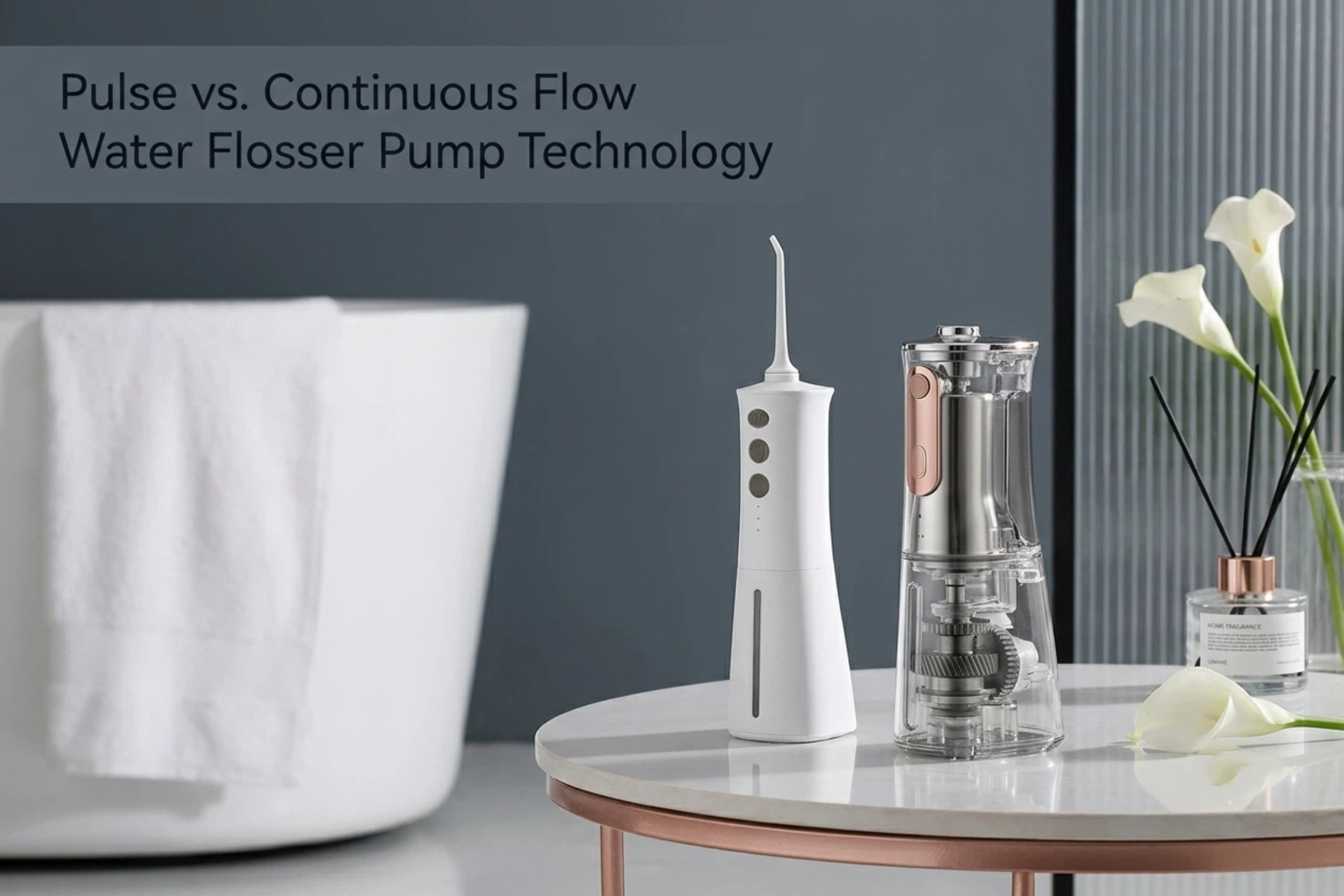
A piston pump water flosser uses a reciprocating piston driven by a small DC motor. On each stroke, the piston draws water from the reservoir and forces it through the nozzle in a pulsed jet. The resulting water stream is not a steady flow — it is a rapid series of high-pressure pulses, typically at 1,200 to 1,800 pulses per minute (20–30 Hz).
Pulse-based water flossers make up roughly 80% of the global oral irrigator market. The reason is straightforward: pulsating water creates a micro-impact effect that dislodges plaque and food debris more effectively than a steady stream. This “hammer and flush” mechanism — impact followed by wash-away — is clinically proven to improve interdental cleaning.
Key technical characteristics of piston pumps:
| Advantages | Disadvantages |
|---|---|
| Clinically validated cleaning efficacy — the pulsating action is backed by dental research | O-ring seal is a consumable wear point — cheap seals degrade within 6–12 months |
| Lower unit cost — mature manufacturing ecosystem with competitive pricing | Higher noise output compared to diaphragm alternatives |
| Widely accepted by consumers — familiar “pulsing” sensation feels effective | Pressure can feel aggressive for users with sensitive gums or receding gumlines |
| Easy to implement multi-mode pressure control (soft / normal / strong) | Performance attenuation over time is more noticeable than diaphragm pumps |
Best for: Entry-level to mid-range water flossers, mass-market retail brands, private-label products targeting value-conscious consumers.
A diaphragm pump water flosser uses a flexible membrane (diaphragm) that oscillates to create suction and discharge cycles. Unlike a piston pump, there is no sliding contact between hard surfaces — the diaphragm flexes, eliminating the friction-based wear that plagues piston seals. The result is a smoother, more continuous water stream with less vibration and significantly lower noise.
Diaphragm pumps are rapidly gaining market share in the mid-to-high-end water flosser segment. The core value proposition is gum comfort and durability. Because the water flow is more uniform (even when pulsed), users experience less gum irritation. This makes diaphragm pumps the go-to choice for brands targeting sensitive-teeth demographics, orthodontic patients, and premium wellness positioning.
Key technical characteristics of diaphragm pumps:
| Advantages | Disadvantages |
|---|---|
| Superior durability — no sliding seal wear, 2–3x lifespan vs. piston pumps | Higher unit cost — typically 15–30% more expensive than equivalent piston pumps |
| Lower noise — 10–15 dB quieter, a major selling point for premium brands | Fewer supplier options — diaphragm pump manufacturing requires specialized tooling |
| Gum-friendly — gentler water delivery reduces user discomfort complaints | Perceived lower “power” — consumers accustomed to aggressive piston pulses may need education |
| Excellent leak resistance — hermetic diaphragm seal minimizes water ingress risk | Less established in certain markets — consumer awareness of “diaphragm pump” terminology is low |
Best for: Premium water flossers, gum-health-focused brands, orthodontic/OEM clinic products, noise-sensitive markets (Japan, Northern Europe), and brands prioritizing low return rates.
An emerging category that savvy water flosser B2B buyers should watch is the compound pump. This architecture combines a piston-driven movement structure with diaphragm-style sealing technology. The result: strong, perceptible pulses (the “cleaning feel” consumers expect) delivered through a leak-resistant, long-lifespan sealed system.
Compound pumps are specifically engineered for high-end water flossers where brands cannot afford to compromise on either cleaning performance or durability. Expect to see this technology become the standard in the $50+ retail price segment within the next 2–3 years.
| Feature | Piston Pump | Diaphragm Pump | Compound Pump |
|---|---|---|---|
| Pulse Feel | Strong & obvious | Gentle & smooth | Strong & refined |
| Seal Durability | Moderate (wear-prone) | Excellent | Excellent |
| Noise Level | 60–75 dB | 50–65 dB | 55–68 dB |
| Expected Lifespan | 150–300 hrs | 300–500+ hrs | 350–500+ hrs |
| Unit Cost (Relative) | $ (Baseline) | $$ (+15–30%) | $$$ (+30–50%) |
| Best Market Position | Entry / Mass-market | Mid-to-high-end | Premium / Flagship |
Your pump decision should be driven by brand positioning, not just BOM cost. Here is a decision framework:
Mass-market / Value-focused (retail $15–$30): A quality piston pump from a reputable supplier is your best bet. Focus on seal quality and motor consistency — do not just take the cheapest quote. Request seal life-cycle test reports and pulse consistency data from your factory.
Mid-range / Performance-focused (retail $30–$60): Consider a diaphragm pump or a high-quality piston pump with brushless motor. The diaphragm pump’s lower noise and better durability become meaningful differentiators at this price point — especially on Amazon, where noise complaints drive negative reviews.
Premium / Specialty / Medical-grade (retail $60+): Opt for a compound pump or a precision-engineered diaphragm pump. At this tier, your buyers expect flawless performance, silent operation, and multi-year durability. A pump that degrades after 6 months is a brand-destroying liability.
At WELLAND, we have invested heavily in pump R&D because we know it is the single biggest determinant of product quality. Our IPX7 cordless water flosser line features pumps that deliver 30% stronger output than conventional models while maintaining consistent pulse uniformity across the entire 220mL tank capacity.
Here is what sets WELLAND pump technology apart for B2B water flosser buyers:
Whether you need a cost-optimized piston pump for mass retail or a whisper-quiet diaphragm pump for a premium dental brand, our OEM/ODM team can engineer the right solution.
Tell us your target market, price point, and performance requirements — our engineering team will recommend the optimal pump architecture and provide a complete OEM proposal within 48 hours.
Request Your OEM Pump Consultation
Trusted by 800+ global brands including ALDI, Rossmann, LIDL, DM, and Action.
Pulse pumps (typically piston-based) deliver water in rapid bursts at frequencies of 1,200–1,800 pulses per minute, creating a micro-impact cleaning effect. Continuous flow pumps (typically diaphragm-based) produce a smoother, more uniform water stream with less vibration. Pulse technology offers stronger perceived cleaning power, while continuous flow prioritizes gum comfort and quieter operation. The choice depends on your brand’s target user profile and market positioning.
Continuous flow (diaphragm pump) technology is generally better for sensitive gums. The smoother water delivery reduces the “shock” sensation that aggressive piston pulses can cause on inflamed or receding gum tissue. However, a well-engineered piston pump with a dedicated “soft” or “gentle” mode (lower pressure + reduced pulse intensity) can also serve sensitive-gum users effectively. For brands specifically targeting the periodontal care market, a diaphragm or compound pump is the stronger choice.
Pulse frequency directly impacts both cleaning efficacy and user comfort. Standard water flossers operate at 1,200–1,800 ppm (20–30 Hz), which research shows is optimal for plaque disruption without excessive gum stimulation. Frequencies below 1,000 ppm feel sluggish and reduce cleaning power. Frequencies above 2,000 ppm can feel aggressive or “buzzy” and may cause user discomfort. For B2B buyers, specifying a frequency range of 1,400–1,600 ppm is a safe sweet spot that balances clinical effectiveness with mass-market comfort.
Your choice depends on three factors: retail price point, target demographic, and brand positioning. Piston pumps suit entry-level to mid-range products ($15–$40 retail) targeting value-conscious consumers. Diaphragm pumps are ideal for mid-to-premium products ($40–$80 retail) where low noise and gum comfort are selling points. Compound pumps are recommended for flagship/premium models ($80+ retail) where no-compromise performance justifies the higher BOM cost. Consult with your manufacturer to match pump architecture to your specific market goals.
Pump lifespan varies significantly by type and quality. A well-made piston pump lasts 150–300 operating hours (approximately 1–2 years of daily use); a diaphragm pump reaches 300–500+ hours (2–4+ years); a compound pump achieves 350–500+ hours. The biggest factors affecting durability are seal quality (piston pumps), motor bearing grade, and waterproofing integrity (IPX7 validation). Always request documented pump life-cycle test data from your manufacturer — a factory that cannot provide this data should raise a red flag.
Don’t Let a Cheap Pump Sink Your Brand.
Partner with a manufacturer that treats pump engineering as a competitive advantage — not a cost center.
Published by the WELLAND Engineering & Product Team. WELLAND is an ISO 9001 & ISO 14001 certified OEM/ODM manufacturer of water flossers and personal care devices, serving 800+ global brands from our facility in Wenzhou, China. Contact us for pump samples, test reports, and OEM proposals.
 EN
EN  RU
RU  PT
PT  FR
FR  ES
ES  KO
KO  JA
JA  DE
DE  ZH
ZH