



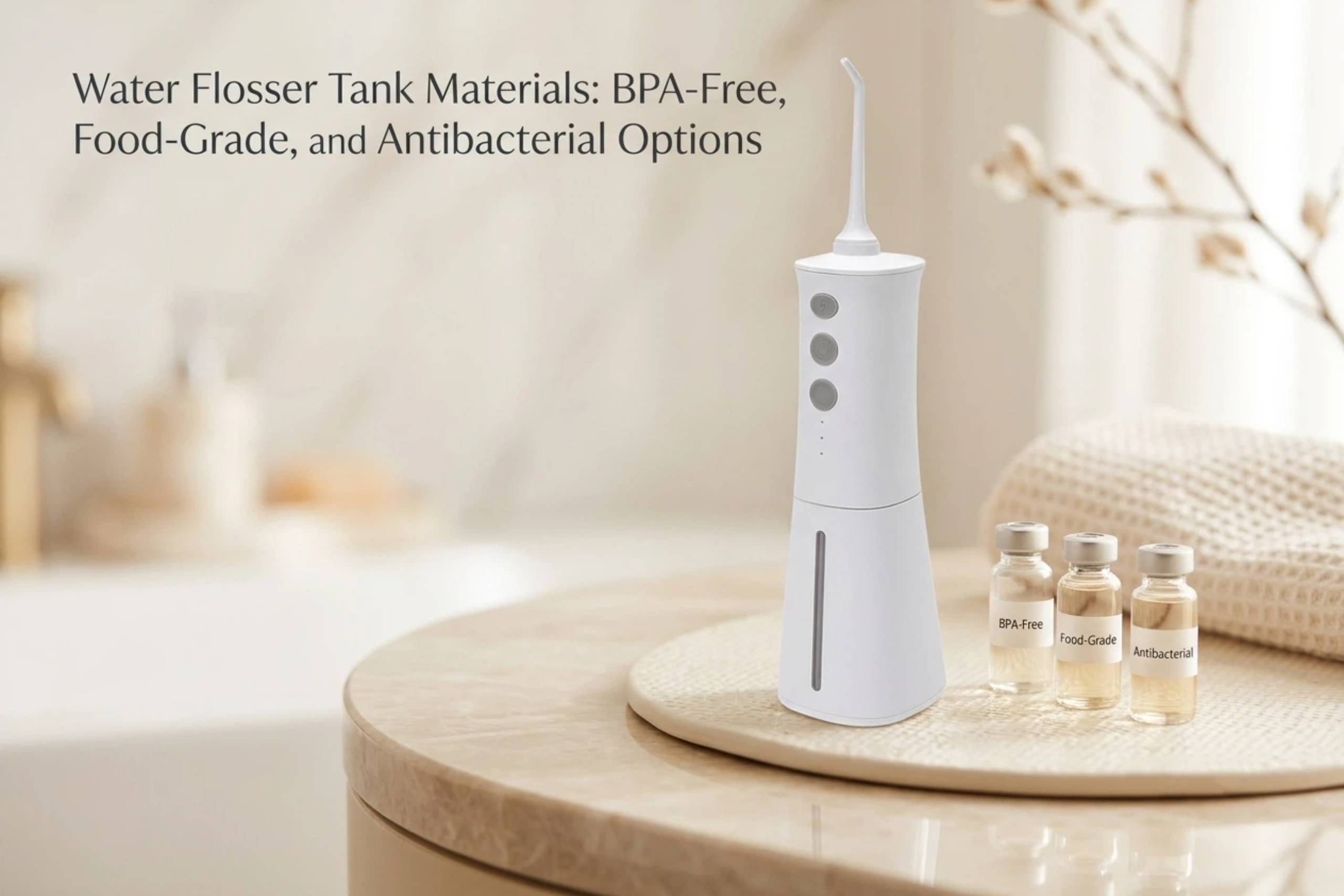
When sourcing water flossers for your brand, the materials that come into direct contact with water deserve just as much scrutiny as motor performance or battery life. The tank is where water sits — sometimes for hours — before it enters a user’s mouth. For B2B buyers, private-label brands, and OEM procurement teams, selecting the right water flosser tank material directly impacts regulatory compliance, customer trust, and long-term product competitiveness.
This guide walks through the three most important categories of water flosser tank materials — BPA-free, food-grade, and antibacterial — and explains what each means in practice. Whether you are selling in the EU, North America, or Asia-Pacific, understanding these material distinctions will help you make informed sourcing decisions and avoid costly compliance setbacks.
The water tank is not just a container. It is the component with the longest direct water contact time in the entire device. A poor material choice can lead to:
For B2B buyers sourcing OEM water flossers, the tank material specification should be locked down during the RFQ stage — not treated as an afterthought.
Most portable water flosser tanks on the market are made from one of four plastic types. Each has distinct properties that affect safety, durability, clarity, and cost.
ABS is the most widely used material for mid-range and mass-market water flosser tanks. It offers a strong balance of impact resistance, dimensional stability, and affordability.
Verdict: A solid entry-to-mid-range choice, especially when the manufacturer uses 100% virgin ABS and provides RoHS / REACH test reports. WELLAND’s current water flosser line uses virgin ABS that has passed RoHS 2.0 testing.
Tritan™ is a premium BPA-free copolyester developed by Eastman Chemical. It is widely used in high-end water bottles, baby products, and medical devices — and increasingly in premium water flossers.
Verdict: The best choice for brands targeting premium segments or markets with strict food-contact regulations (EU, North America). Tritan’s BPA-free claim is backed by Eastman’s full technical documentation, which simplifies compliance paperwork for importers.
Polycarbonate was once the default clear plastic for water containers. It is still found in some budget water flossers, but its use is declining due to BPA concerns.
Verdict: Not recommended for new product development. The regulatory headwinds are too strong, and the BPA risk creates unnecessary liability for brands and importers. If your current OEM supplier uses PC tanks, this should be a red flag during factory evaluation.
Polypropylene occasionally appears in entry-level or ultra-budget water flosser tanks.
Verdict: Budget option only. The lack of transparency makes it harder for users to monitor water level and tank cleanliness — a usability trade-off that may hurt reviews and repeat purchases.
The term “BPA-free” appears on countless product pages, but what does it actually obligate a manufacturer to deliver — and what should B2B buyers verify?
Bisphenol A (BPA) is an endocrine-disrupting chemical. Studies have linked BPA exposure to hormonal disruption, developmental issues, and increased cancer risk. The concern is amplified for oral care products because water sits in the tank and then enters the mouth — creating a direct ingestion pathway.
When your brand claims “BPA-free,” you are making an assertion that regulators and consumers can hold you accountable for. To substantiate this claim, your OEM manufacturer should provide:
Simply asking “is this BPA-free?” and receiving a verbal “yes” is not sufficient due diligence for a B2B buyer placing a container order. You need documentation.
| Market | Key Regulation | BPA Requirement |
|---|---|---|
| European Union | EU Regulation 10/2011 (Food Contact Plastics); REACH | BPA migration limit: 0.05 mg/kg; banned from baby bottles since 2011; food-contact plastics must pass overall migration tests |
| United States | FDA 21 CFR; California Prop 65 | FDA banned BPA in baby bottles (2012); Prop 65 requires warning labels if BPA is present above safe harbor levels; consumer class-action risk is high for unlabeled BPA products |
| Canada | Canada Consumer Product Safety Act | BPA listed as toxic substance; banned in baby bottles; strict limits on food-contact plastics |
| Australia / NZ | AS 2070; FSANZ | Voluntary phase-out by major retailers; regulatory expectations aligned with EU standards |
“Food-grade” is another widely used marketing term that can mean almost nothing without supporting evidence. Here is what B2B buyers should look for when a manufacturer claims food-grade tank materials.
In the United States, the FDA evaluates the safety of substances that contact food through the Food Contact Notification program. Materials like Tritan™ have received FCN clearance, meaning the FDA has reviewed Eastman’s safety data and found no objection to the material’s use in food-contact applications — including repeated use.
For a water flosser tank, this is relevant because water is considered a food-simulating liquid in migration testing. A tank material with FDA FCN clearance gives your brand a defensible “food-grade” claim.
This is the umbrella regulation governing all food-contact materials in the EU. It requires that materials do not transfer constituents to food in quantities that could endanger human health or cause unacceptable changes in composition. For plastics specifically, Regulation (EU) No 10/2011 sets out specific migration limits, including a BPA-specific migration limit of 0.05 mg/kg.
If your OEM supplier cannot produce these documents for their tank material, the “food-grade” label on your product page is legally vulnerable — and so is your brand.
Some manufacturers — particularly those targeting the Japanese, Korean, and premium European markets — now offer antibacterial water flosser tanks. These incorporate antimicrobial additives into the plastic during the molding process.
Two main technologies are in use:
Antibacterial claims must be substantiated by standardized tests. The most recognized standards include:
A legitimate antibacterial tank should have test reports showing >99% reduction of E. coli and Staphylococcus aureus within 24 hours under ISO 22196 conditions.
For most mainstream and value-segment brands, a properly cleaned BPA-free, food-grade tank is sufficient. The antibacterial upgrade adds roughly 15–25% to the tank component cost and makes the most sense for:
| Feature | ABS (Virgin) | Tritan™ | PC | PP |
|---|---|---|---|---|
| BPA-Free | ✅ (verified) | ✅ (inherent) | ❌ Risk | ✅ (inherent) |
| FDA Food Contact | Depends on grade | ✅ FCN cleared | ❌ Restricted | ✅ Common |
| Clarity | Semi-transparent | Glass-like clear | Clear | Translucent |
| Impact Resistance | ★★★★☆ | ★★★★★ | ★★★★★ | ★★★☆☆ |
| Chemical Resistance | ★★★☆☆ | ★★★★★ | ★★☆☆☆ | ★★★☆☆ |
| Cost Level | $$ | $$$$ | $$ | $ |
| Best For | Mid-range, mass market | Premium, regulated markets | Not recommended | Budget / promotional |
As a B2B OEM/ODM manufacturer serving 800+ global partners, WELLAND treats material safety as a foundational part of the production process — not a checkbox.
Here is how our tank material quality assurance works:
We recommended all B2B buyers to review the 20-point factory evaluation checklist before finalizing any manufacturing partnership, where material sourcing is one of the core checkpoints.
Whether you need BPA-free ABS for a mid-range SKU, FDA food-contact Tritan™ for a premium launch, or antibacterial tanks for a differentiated product line, WELLAND can match the material spec to your target market requirements. Share your project brief and receive a tailored OEM proposal with material documentation included.
Yes, when it is virgin (non-recycled) ABS that has been formulated without BPA and tested to relevant standards such as RoHS 2.0 or REACH. The key is documentation: your OEM supplier should provide third-party test reports confirming BPA-free status and overall migration compliance. WELLAND uses 100% virgin ABS with RoHS 2.0 certification for all water-contact components.
BPA-free means the material does not contain or release bisphenol A — it is a specific chemical exclusion. Food-grade is a broader category that includes BPA exclusion plus overall migration limits, sensory neutrality (no taste/odor transfer), and compliance with food-contact regulations like FDA FCN or EU 10/2011. A material can be BPA-free without being fully food-grade certified, but food-grade certification always implies BPA-free. For premium brands, food-grade certification provides stronger legal protection for marketing claims.
Yes, silver-ion antibacterial tanks tested to ISO 22196 typically show >99% bacterial reduction on the tank surface within 24 hours. However, this does not mean the tank is self-cleaning — users still need to empty and air-dry the tank between uses. The antibacterial property primarily slows biofilm formation and reduces odor-causing bacteria between cleanings. It is a meaningful value-add for premium products but not a substitute for basic hygiene.
Yes. For OEM/ODM orders, WELLAND can source and manufacture tanks in ABS, Tritan™, or antibacterial-grade plastics based on your specification. Material selection is part of the product definition phase, and we provide supplier documentation and test reports before production begins. The MOQ and lead time may vary depending on material availability and tooling requirements.
For the EU market, the tank material should be supported by: RoHS 2.0 compliance (hazardous substance restriction), REACH compliance (chemical safety), and EU Regulation 10/2011 migration test reports (specific to food-contact plastics). A Declaration of Compliance (DoC) that ties these reports together is the standard document importers should keep on file. If you are making “BPA-free” or “food-grade” claims on your packaging, these documents are your legal defense in case of a challenge from market surveillance authorities.
Continue building your sourcing knowledge with these articles from the WELLAND blog:
 EN
EN  RU
RU  PT
PT  FR
FR  ES
ES  KO
KO  JA
JA  DE
DE  ZH
ZH