



If you are importing electric cleaning brush kits for your brand, you already know the unit economics. But what happens after your customer has been using the brush for three months and the bristles start to wear down? That moment — the replacement moment — is where the real profit lives.
The global market for electric cleaning brush accessories and consumables is growing at over 8% CAGR, yet most B2B buyers still treat replacement heads as an afterthought. They negotiate hard on kit pricing while leaving the accessory revenue stream entirely untapped. This is a mistake. For every $100 you make selling cleaning brush kits, the aftermarket accessory ecosystem can generate $40–$60 in additional recurring revenue — often at double the gross margin of the original kit sale.
This guide breaks down the complete electric cleaning brush accessory ecosystem: the types of replacement heads your brand needs, adapter compatibility strategies that lock in repeat customers, revenue forecasting models, inventory planning ratios, and how to work with your OEM manufacturer to build a proprietary accessory line that competitors cannot replicate.
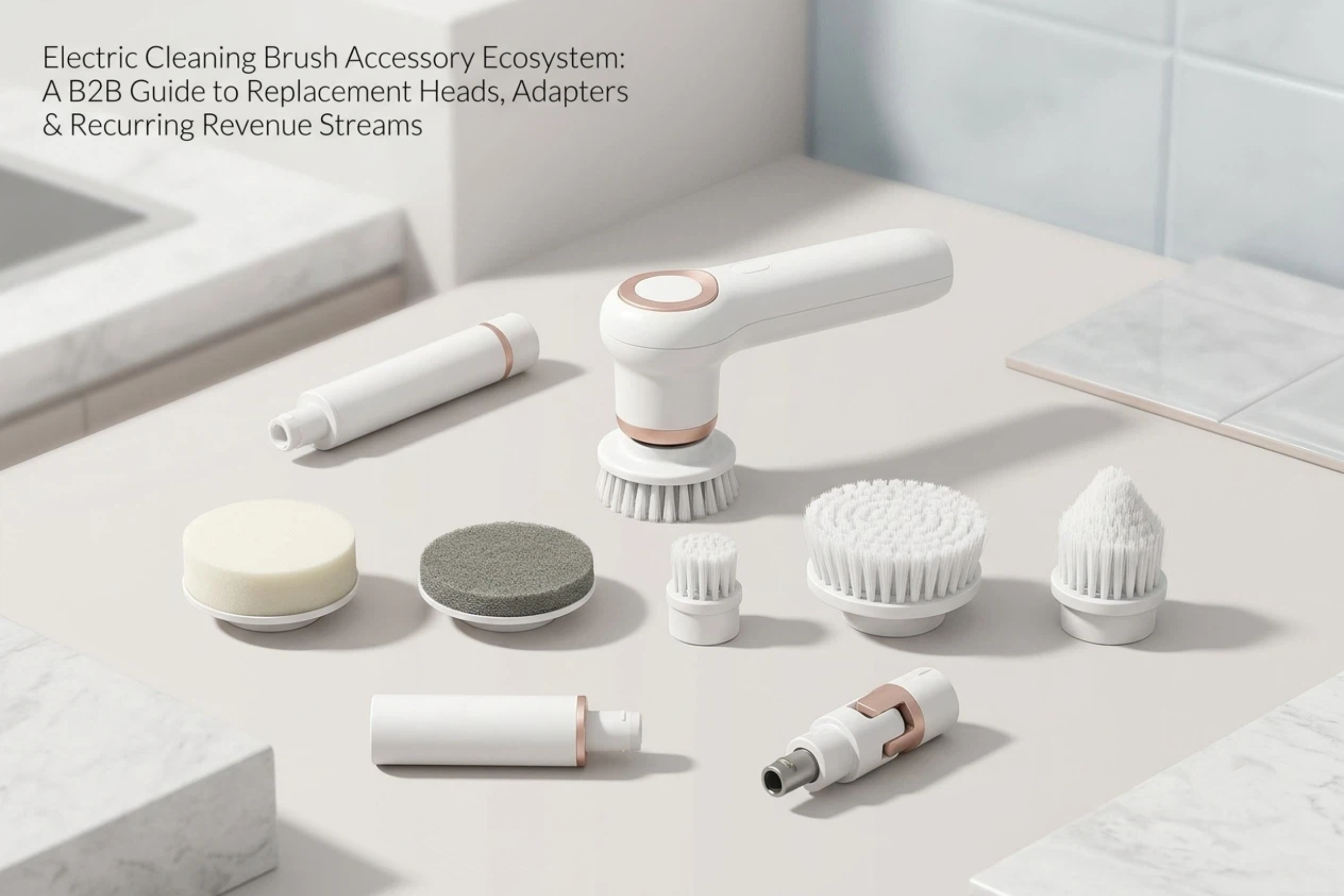
Not all replacement brush heads are created equal — in terms of manufacturing cost, end-user demand, or profit margin. Understanding which heads drive the most reorder volume is the foundation of any accessory revenue strategy.
A typical electric cleaning brush kit ships with a multi-head set. Here is how each head type performs from a B2B accessory perspective:
| Brush Head Type | Primary Use Case | Wear Rate | Reorder Demand | Unit Cost (OEM) | Rec. Wholesale | Gross Margin |
|---|---|---|---|---|---|---|
| Flat Brush | General scrubbing — floors, tiles, countertops | High | Very High | $0.15–$0.30 | $0.60–$0.90 | 50–65% |
| Round Brush | Large surfaces — bathtubs, shower walls | High | Very High | $0.20–$0.35 | $0.70–$1.00 | 55–65% |
| Corner Brush | Tight spaces — corners, edges, grout lines | Medium | Medium | $0.12–$0.25 | $0.50–$0.80 | 50–60% |
| Sponge Head | Delicate surfaces — glass, mirrors, polished tiles | Medium-High | High | $0.10–$0.20 | $0.40–$0.70 | 55–70% |
| Scouring Pad | Tough stains — ovens, stove tops, baked-on grease | High | Medium-High | $0.08–$0.18 | $0.35–$0.60 | 60–70% |
| Wire Brush | Heavy-duty — rust, grout, outdoor surfaces | Low-Medium | Low-Medium | $0.20–$0.40 | $0.60–$1.10 | 50–60% |
| Wool Pad | Polishing & buffing — car surfaces, furniture, fixtures | Medium | Medium | $0.15–$0.35 | $0.50–$0.90 | 50–60% |
Note: Unit costs are indicative for OEM orders at 5,000+ unit quantities with ABS plastic base and standard bristle materials. Custom materials (nylon 6.12, silicone tips, microfiber pads) will adjust pricing accordingly.
Based on WELLAND’s order data across 800+ global B2B clients, the flat brush and round brush together account for approximately 55–65% of all replacement head reorders. The sponge head follows at 15–20%, with the remaining four types splitting the balance. This pattern holds across both European and North American markets, though Middle Eastern buyers tend to order heavier on scouring pads due to different cleaning habits and surface types.
Actionable insight for B2B buyers: When negotiating your initial OEM/ODM electric cleaning brush manufacturing contract, negotiate tiered pricing based on head type. Flat brushes and round brushes should command the deepest volume discounts because they anchor your recurring revenue pipeline.
The physical interface between the cleaning brush motor shaft and the replacement head — the adapter system — is the single most strategic decision in building an accessory ecosystem. Get it right, and your customers have no reason to buy from a competitor. Get it wrong, and you are subsidizing someone else’s aftermarket.
| Adapter Type | Brand Lock-In | Tooling Cost | Compat. Risk | Best For |
|---|---|---|---|---|
| Universal Quick-Release Industry-standard 4-tab bayonet mount, compatible with most generic heads on market | Low | $0 | High | Fast market entry, discount brands, retail private labels where accessory exclusivity is not a priority |
| Proprietary Snap-Lock Custom-designed interface — unique tab count, spacing, or locking mechanism | High | $2,000–$5,000 | Low | Premium brands building long-term accessory revenue, brands in competitive retail channels |
| Hybrid Mount System Standard motor-shaft base + unique brush-head interface plate — best of both worlds | Medium-High | $1,500–$3,500 | Low-Medium | Balanced approach — enables accessory lock-in while keeping motor unit production flexible |
A $3,000 custom adapter tooling investment amortized across a 50,000-unit production run adds just $0.06 per unit — less than the cost of a single brush head. Yet the return is exponential: brands with proprietary adapter systems report 60–80% attachment rates on replacement head sales, compared to 25–35% for universal-mount brands. That 2–3x difference in accessory revenue compounds across every kit sold.
WELLAND’s engineering team designs and manufacturers all three adapter types. During your OEM product development phase, we provide CAD drawings, 3D-printed prototype adapters, and compatibility testing documentation before committing to mold production.
Let us move from theory to numbers. Here is a practical revenue model that B2B buyers can apply to their own sales projections.
Annual Accessory Revenue = A x B x C – D
A = Number of brush kits sold per year
B = Average replacement head sets ordered per kit owner per year (industry avg: 2–4)
C = Wholesale price per replacement head set
D = Logistics & fulfillment costs for accessory shipments
| Revenue Component | Conservative | Moderate | Optimistic |
|---|---|---|---|
| Annual Kit Sales | 30,000 | 50,000 | 100,000 |
| Attachment Rate | 25% (universal adapter) | 45% (hybrid adapter) | 65% (proprietary adapter) |
| Avg Refill Sets per Attached Customer | 2/year | 3/year | 4/year |
| Total Refill Sets Sold | 15,000 | 67,500 | 260,000 |
| Wholesale Price per 7-Head Set | $3.00 | $3.50 | $3.50 |
| Annual Accessory Revenue | $45,000 | $236,250 | $910,000 |
| Accessory Gross Profit (55% margin) | $24,750 | $129,938 | $500,500 |
The delta between a universal-adapter strategy and a proprietary-adapter strategy at 50,000 kits/year is massive — over $190,000 in additional annual accessory revenue. This is revenue that compounds year over year as your installed base of brush kits grows.
The classic Gillette model — sell the handle at low margin, profit on the blades — translates directly to electric cleaning brushes. Forward-thinking B2B brands are already pricing their initial brush kit aggressively (sometimes at 15–18% margin) to maximize market penetration, then capturing 50–65% margins on the recurring accessory stream. This strategy works because:
One of the most common B2B procurement mistakes is under-ordering replacement accessories relative to kit volume. Here is a data-driven framework for getting your ratios right from day one.
| Product Stage | Kits : Replacement Head Sets | Rationale |
|---|---|---|
| Market Entry (New Launch) | 1 : 2 | Conservative ratio while you measure actual reorder patterns. Minimizes excess inventory risk while ensuring availability. |
| Growth Phase (6–12 months in market) | 1 : 3 | Adjust based on first-wave reorder data. This ratio covers approximately 12 months of aftermarket demand for the average brand. |
| Mature Brand (1+ year established) | 1 : 4 to 1 : 5 | Established reorder patterns justify heavier accessory stock. Proprietary-adapter brands with 60%+ attachment rates should lean toward 1:5. |
Accessory demand is not flat across the year. Q4 (October–December) typically sees a 30–40% spike in replacement head reorders across all markets, driven by holiday gifting of new kits and pre-holiday deep cleaning. For B2B importers, this means placing your accessory restock order by August at the latest to ensure Q4 shelf availability — sea freight from China to EU/US ports takes 30–45 days, plus customs clearance and inland distribution.
WELLAND supports mixed-container shipping: you can combine kits, accessories, and even cross-category products (such as water flosser accessories) in a single container to optimize freight costs. Our logistics team can help you model the most cost-efficient container mix for your target market.
The accessories you sell are a direct extension of your brand. Generic, unbranded replacement heads erode brand equity and invite price comparison. Custom OEM accessories protect your margins and reinforce your brand with every reorder.
| Customization Element | Options at WELLAND | MOQ Impact |
|---|---|---|
| Bristle Material | Nylon 6.6, Nylon 6.12 (superior chemical resistance), PP, TPE (softer), silicone tips, microfiber | None — materials are batch-based |
| Bristle Stiffness & Density | Soft / Medium / Hard / Extra Hard; density from 40 to 120 tufts per head | None |
| Head Base Color | Full PMS color matching via masterbatch injection | 3,000 pcs/color typical |
| Adapter Interface | Custom mold for proprietary snap-lock or hybrid mount | Tooling: $2,000–$5,000 one-time. Production: 5,000+ pcs |
| Brand Marking | Laser engraving, pad printing, in-mold label (IML) | 3,000 pcs typical (laser: no MOQ impact) |
| Retail Packaging | Custom blister card, hang-tab box, multi-pack shrink wrap, display-ready carton | Custom print: 3,000+ units. Standard design: any qty |
For a complete walkthrough of the customization process — from design brief to mass production — see our detailed guide on electric cleaning brush OEM vs ODM.
Accessories are not exempt from regulatory requirements. Replacement brush heads sold in EU and North American markets must comply with the same material safety and quality standards as the parent kit. Here is what importers need to verify:
| Standard | Applies To | Key Requirements |
|---|---|---|
| RoHS (EU) | All brush head materials (ABS, nylon, metal components) | Limits lead, mercury, cadmium, hexavalent chromium, PBBs, PBDEs to safe thresholds. Mandatory for CE marking. |
| REACH (EU) | Chemical substances in plastics and dyes | Registration, evaluation, and authorization of chemicals. Covers SVHC (substances of very high concern). |
| FDA (US) | Brush heads marketed for food-contact surfaces | Food-grade material certification if heads are marketed for kitchen/utensil cleaning. |
| PAH (EU — GS Mark) | Plastic and rubber components with prolonged skin contact | Limits polycyclic aromatic hydrocarbons in consumer products. Category 1 (< 0.2 mg/kg) applies to cleaning tools. |
| Durability Testing | All brush heads | Spin-cycle endurance (5,000+ cycles at 310 RPM), bristle retention test, adapter connection fatigue test. |
All WELLAND electric cleaning brush accessories are manufactured under ISO 9001 quality management and comply with CE, RoHS, and PAH standards. We provide full compliance documentation with every shipment. For a deeper dive into certification requirements, refer to our guide: CE, RoHS, and FCC Certification for Electric Cleaning Brushes: What Importers Must Know.
From proprietary adapter design to custom-branded packaging, WELLAND’s OEM team handles your entire accessory ecosystem under one roof. With 800+ B2B partners across 50+ countries, we understand what it takes to build a profitable aftermarket — not just ship boxes of brush heads.
Request Accessory Quote
Download Product Catalog
MOQ from 3,000 pcs | Free samples available | 35–45 day lead time
Not sure which adapter system fits your brand strategy?
Talk to our engineering team. We will review your target market, sales channel, and competitive landscape — then recommend the optimal accessory configuration for your product line.
Electric cleaning brush kits typically include 5–7 brush head types: flat brush (general scrubbing), round brush (large surfaces), corner brush (tight spaces), sponge head (glass/mirrors), scouring pad (tough stains), wire brush (grout/rust), and wool pad (polishing). For B2B accessory sales, the flat brush and round brush together account for 55–65% of all replacement orders due to their high wear rate and universal application. Sponge heads follow as the third-highest reorder item. B2B buyers should prioritize these three types in their initial accessory inventory, then expand based on actual end-user reorder data.
The recurring revenue formula is: Annual Kit Sales x Attachment Rate x Average Refill Sets per Customer x Wholesale Price per Set. For example, a brand selling 50,000 kits/year with a 45% attachment rate, 3 refill sets per customer annually, and a $3.50 wholesale price per 7-head set generates approximately $236,250/year in pure accessory revenue. The key metric to track is attachment rate — this is most influenced by your adapter strategy (proprietary vs. universal) and how easy you make it for customers to reorder (packaging inserts, QR codes, dedicated accessory SKUs with your retail partners).
Three adapter approaches exist: (1) Universal quick-release — standard 4-tab bayonet mount compatible with generic market heads; lowest cost, lowest brand lock-in; (2) Proprietary snap-lock — custom-designed interface unique to your brand; $2,000–$5,000 tooling investment, but drives 60–80% attachment rates; (3) Hybrid mount system — standard motor-shaft base with a unique brush-head interface plate; balances flexibility with accessory lock-in. WELLAND designs and manufactures all three types through our OEM service. The right choice depends on your brand positioning, target retail channel, and accessory revenue goals.
Replacement heads typically deliver 40–60% gross margin compared to 20–35% for the complete brush kit. This margin advantage comes from three factors: (1) simpler manufacturing — no motor, battery, PCB, or waterproof sealing required; (2) lower shipping costs — a replacement head set is lighter and more compact than a full kit; (3) zero customer acquisition cost — the buyer is already in your ecosystem. A 7-head replacement set with a landed cost of $1.20–$1.80 and a wholesale price of $3.00–$3.50 generates strong, predictable recurring profit. Many successful B2B brands structure their pricing so that the initial kit serves as a customer acquisition vehicle, while accessory refills drive long-term profitability.
The recommended starting ratio is 1:2 to 1:3 (kits to replacement head sets). For a 10,000-unit kit order, stock at least 20,000–30,000 replacement head sets — approximately 140,000–210,000 individual heads across the 7 types, allocated proportionally based on wear-rate data. Adjust ratios based on: (a) your adapter type — proprietary-adapter brands should target 1:4 or higher due to stronger aftermarket lock-in; (b) market maturity — new launches start conservative at 1:2, scaling as reorder data confirms attachment rates; (c) seasonality — pre-stock 30% extra before Q4 to cover holiday-driven demand spikes. WELLAND’s flexible MOQ and mixed-container shipping options help B2B buyers optimize inventory costs while ensuring accessory availability.
Yes. All WELLAND OEM replacement brush heads support full brand customization: laser-engraved or pad-printed logos on each head base, custom PMS color matching via masterbatch injection, and fully custom retail packaging (blister cards, branded boxes, multi-pack displays). The minimum order quantity for custom-branded replacement heads starts at 3,000 units per SKU — and laser engraving has no MOQ impact since it is a post-production process. For pure ODM orders (using our existing molds without modification), MOQ can start as low as 500–1,000 units with standard packaging and your logo applied.
For ODM orders using existing molds: 25–35 days from order confirmation to shipment, including logo application and custom packaging. For OEM orders requiring new adapter molds or custom bristle configurations: 45–60 days including tooling, sampling, and client approval. WELLAND provides real-time production tracking and pre-shipment quality inspection reports so you always know exactly where your order stands.
This article was written by the WELLAND content team to help B2B buyers make informed decisions about electric cleaning brush accessory sourcing. For specific product inquiries, custom accessory design, or bulk pricing, please contact our sales team directly. All pricing figures are indicative and subject to confirmation based on order volume, customization scope, and current material costs.
 EN
EN  RU
RU  PT
PT  FR
FR  ES
ES  KO
KO  JA
JA  DE
DE  ZH
ZH