



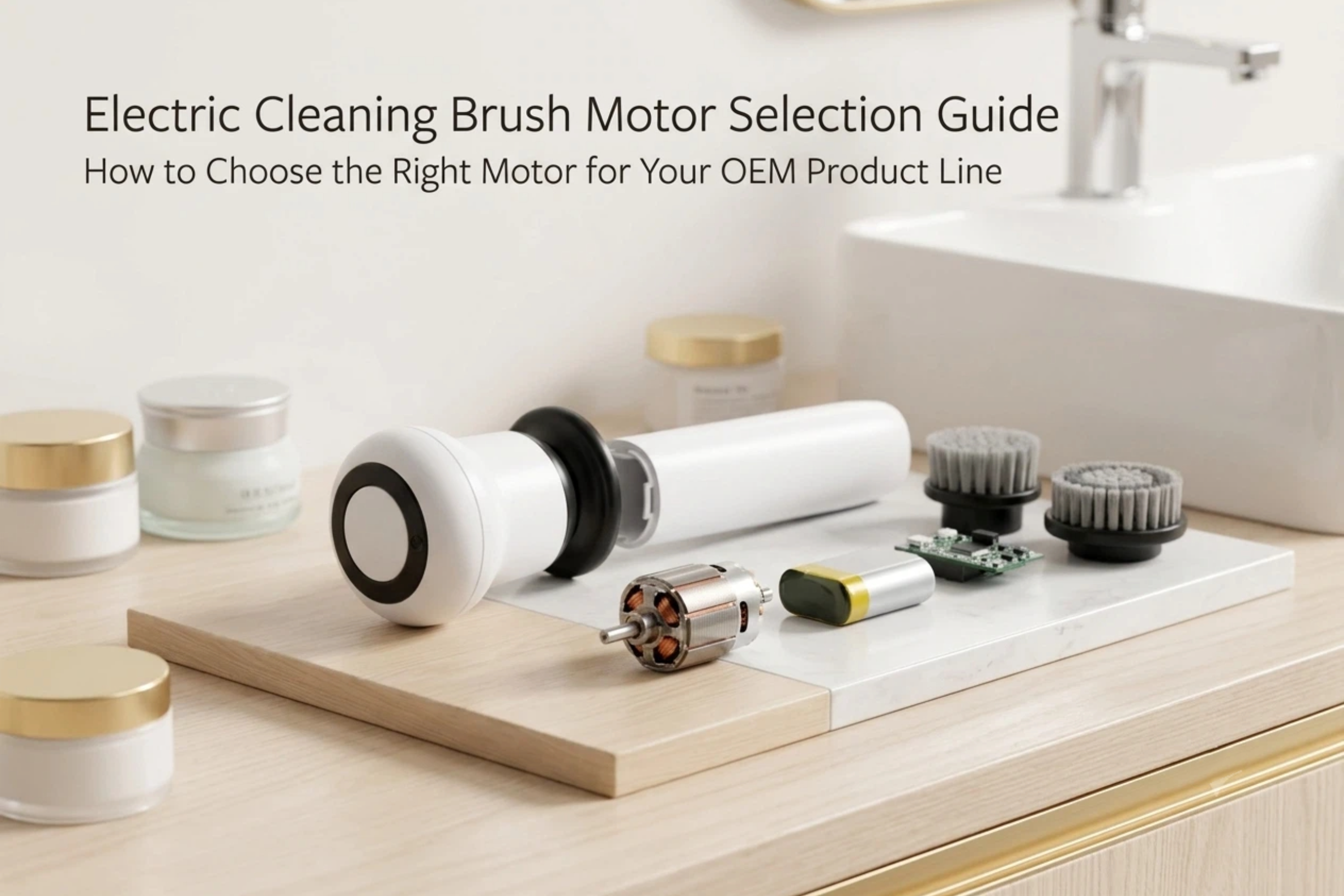
Every electric cleaning brush on the market is only as good as the motor inside it. If you are sourcing cleaning brushes for your brand — whether you are a private-label seller, a retail chain buyer, or a distributor entering the home cleaning category — the motor decision you make today will define your product’s performance, return rate, profit margin, and brand reputation for years to come.
Yet most B2B buyers evaluate motors based on a single number: RPM. That is a mistake. A 350 RPM gear motor with 3.5 kg·cm of torque will outperform a 400 RPM standard brushed motor in heavy-duty cleaning — but if you only compare RPM, you would pick the wrong motor every time.
This guide gives you a framework for making motor decisions that align with your product line positioning, target market, and margin requirements. By the end, you will know exactly what specifications to ask for when you send your next RFQ to an electric cleaning brush manufacturer.
Key Takeaway: The right motor balances four factors — cleaning power (torque + RPM), runtime (battery efficiency), durability (motor type + build quality), and compliance (CE, RoHS, FCC). Ignoring any one of these creates downstream problems that are far more expensive to fix than getting the motor right from the start.
In the B2B personal care and home cleaning appliance supply chain, the motor is not just a component — it is the product’s performance engine. When a retail buyer tests your sample against three competitors, the motor determines whether they feel scrubbing power or disappointment. When an end user runs the brush for the first time, the motor’s noise level and vibration quality shape their entire perception of your brand.
Think about this: the housing, color, packaging, and even brush head design are all surface-level decisions. The motor determines three things that no amount of branding can fix:
Professional procurement teams at retail chains like ALDI, LIDL, and ACTION — all of whom are active buyers in the electric cleaning brush category — evaluate products through a structured lens. Motor specifications appear on their technical requirement checklists alongside certifications and packaging compliance. If your motor cannot pass a basic performance benchmark test, your product never reaches the negotiation table.
For Amazon and e-commerce sellers, the stakes are equally high. A motor that overheats after 15 minutes of continuous use generates negative reviews that tank your listing’s conversion rate. A motor with inconsistent torque across production batches creates a quality variance problem that leads to returns, account health warnings, and ultimately, delisting.
The electric cleaning brush market uses four main motor types. Each has distinct trade-offs in cost, performance, durability, and application fit. Understanding these differences is the foundation of smart sourcing.
Brushed DC motors are the most common motor type in entry-level and mid-range electric cleaning brushes. They use carbon brushes to transfer current to the rotor, which creates rotation through electromagnetic interaction.
Typical specifications in cleaning brush applications:
| Specification | Typical Range |
|---|---|
| RPM (no-load) | 250 – 400 RPM |
| Rated Voltage | 3.7V – 7.4V DC |
| Motor Lifespan | 150 – 300 hours |
| Noise Level | 60 – 75 dB |
| Unit Cost (bulk OEM) | $0.80 – $2.50 |
Best for: Entry-level product lines targeting price-sensitive markets, promotional bundles, or private-label products where cost-per-unit is the primary decision driver.
Limitations: Carbon brush wear generates dust and eventually causes motor failure. Higher electrical noise (EMI) may require additional filtering for FCC compliance. Less energy-efficient, which reduces battery runtime at the same battery capacity.
Brushless DC motors eliminate physical carbon brushes entirely. Instead, an electronic controller commutates the current, driving the rotor through precisely timed magnetic field changes. This fundamental design difference creates measurable advantages across every performance dimension.
Typical specifications in cleaning brush applications:
| Specification | Typical Range |
|---|---|
| RPM (no-load) | 250 – 500 RPM |
| Rated Voltage | 7.4V – 12V DC |
| Motor Lifespan | 500 – 1,000+ hours |
| Noise Level | 45 – 60 dB |
| Unit Cost (bulk OEM) | $3.50 – $8.00 |
Best for: Mid-range to premium product lines targeting European and North American markets, products with extended warranty periods (12+ months), and brands that compete on user experience rather than price alone.
Advantages over brushed motors: 30-50% higher energy efficiency (translating to longer battery runtime at the same capacity), significantly quieter operation, no brush dust contamination, consistent torque across the lifespan, and far better EMI characteristics for FCC testing.
Gear motors pair a standard DC motor (brushed or brushless) with a planetary or spur gear reduction system. The gearbox trades rotational speed for increased torque output — a critical trade-off for applications requiring sustained scrubbing pressure against resistant surfaces.
Typical specifications:
| Specification | Typical Range |
|---|---|
| Output RPM | 150 – 350 RPM |
| Torque (stall) | 3.0 – 8.0 kg·cm |
| Gear Ratio | 10:1 – 50:1 (application-dependent) |
| Gear Material | Metal (preferred) or reinforced nylon |
| Unit Cost (bulk OEM) | $2.00 – $6.00 |
Best for: Heavy-duty cleaning brushes targeting bathroom, kitchen, and outdoor cleaning applications. Products marketed with phrases like “professional-grade scrubbing power” or “stubborn stain removal” almost always use a gear motor.
Critical sourcing note: The gear material is as important as the motor itself. Metal gears (brass or steel) cost more but last dramatically longer than nylon gears, which can strip under sustained high-torque loads. If your product targets heavy-use scenarios, metal gears should be non-negotiable in your RFQ.
Coreless motors use a self-supporting cylindrical winding instead of a traditional iron-core rotor. This design eliminates iron losses (eddy currents and hysteresis), making them more efficient at low to medium loads. They are lighter, respond faster to voltage changes, and produce less vibration — but they are generally not designed for sustained high-torque applications.
Best for: Lightweight, travel-friendly cleaning brushes, facial cleansing brushes, and compact handheld scrubbers where portability and low noise are prioritized over maximum scrubbing power.
Motor Type Decision Framework: If your product’s primary selling proposition is cleaning power → gear motor. If it is premium feel + low noise + long lifespan → brushless DC. If it is aggressive retail price point → brushed DC. If it is ultra-portability → coreless. The motor type must align with your brand’s value proposition — otherwise you are engineering a mismatch that will show up in reviews and returns.
When you receive a motor datasheet from a supplier, it will contain 10-20 parameters. The following six specifications are the ones that actually determine whether the motor works for your product line. Everything else is secondary.
RPM is the most commonly quoted motor specification — and the most commonly misunderstood. Higher RPM does not automatically mean better cleaning. The relationship between RPM and cleaning performance depends on brush head diameter, bristle stiffness, and applied pressure.
| RPM Range | Application Fit | Note |
|---|---|---|
| 180 – 250 RPM | Heavy-duty scrubbing (tile, grout, oven) | Requires high torque to maintain speed under load |
| 250 – 350 RPM | General household cleaning (bathtub, sink, countertop) | Sweet spot for most consumer product lines |
| 350 – 500 RPM | Light cleaning / polishing (glass, chrome fixtures) | Higher risk of splashing and reduced control |
What to ask your supplier: Request RPM under load, not just no-load RPM. A motor that spins at 350 RPM with no resistance might drop to 180 RPM when pressed against a dirty surface. The load RPM is what your customer actually experiences.
If RPM is about speed, torque is about force. Torque determines whether the brush head keeps spinning when pressed against a stubborn stain — or stalls. This is the specification that separates a cleaning brush that works from one that just vibrates.
For electric cleaning brushes, torque typically ranges from 1.5 kg·cm (entry-level brushed motors) to 6.0+ kg·cm (brushless gear motors). As a general rule for OEM buyers:
What to ask your supplier: Request both rated torque (continuous operating torque) and stall torque (maximum torque before the motor stops). The ratio between them indicates how much headroom the motor has before it struggles.
The motor’s rated voltage directly determines your battery configuration. Most handheld electric cleaning brushes operate at 3.7V (single lithium cell) or 7.4V (two cells in series). Higher voltage generally enables higher torque and RPM, but at the cost of increased battery size, weight, and charging complexity.
A 3.7V system with a 1,200mAh battery (common in the category, as seen in WELLAND’s rechargeable cleaning brush lineup) delivers approximately 45-60 minutes of continuous runtime with a brushed DC motor at 310 RPM. Switching to a brushless motor with the same battery can extend runtime to 70-90 minutes due to the efficiency gain — a selling point that directly impacts your product’s market positioning.
| Motor Voltage | Battery Configuration | Typical Runtime (1200mAh) | Application |
|---|---|---|---|
| 3.7V | 1S (single cell) | 45 – 60 min (brushed) | Standard household cleaning |
| 7.4V | 2S (two cells) | 50 – 75 min (brushless) | Professional / heavy-duty cleaning |
Motor noise is one of the most frequently mentioned complaints in electric cleaning brush reviews across Amazon and retail feedback channels. For B2B buyers selling into noise-sensitive markets — particularly Japan, Germany, and Scandinavia — motor noise below 60 dB is increasingly a table-stakes requirement rather than a differentiator.
Brushless motors produce 10-20 dB less noise than equivalent brushed motors. Gear motors are inherently louder due to gear mesh noise. If noise is a critical specification for your market, specify the measurement distance (typically 30 cm or 1 meter) and whether the reading is A-weighted (dBA) in your RFQ — otherwise comparisons between suppliers are meaningless.
Electric cleaning brushes are used in wet environments by design. The motor’s waterproof rating — or more precisely, the motor housing’s sealing design — determines whether moisture ingress will cause corrosion, short circuits, or complete motor failure.
| IPX Rating | Protection Level | Suitable For |
|---|---|---|
| IPX4 | Splash-proof (any direction) | Light cleaning, minimal water exposure |
| IPX5 | Water jets (6.3mm nozzle) | Standard bathroom/kitchen use — industry minimum |
| IPX6 | Powerful water jets (12.5mm nozzle) | Heavy water exposure, outdoor cleaning |
| IPX7 | Immersion up to 1m for 30 min | Premium / professional-grade products |
IPX5 is the practical minimum for any electric cleaning brush sold into Western markets. Products rated below IPX5 will generate disproportionate warranty claims and returns, particularly from users cleaning showers, bathtubs, and outdoor surfaces.
Motor lifespan is typically specified in hours of continuous operation under rated load. For brushed motors, lifespan is limited by carbon brush wear. For brushless motors, bearing quality is the primary lifespan determinant.
A quality-focused manufacturer should be able to provide accelerated life test data: running the motor continuously at 1.2x rated voltage until failure, then projecting the equivalent lifespan at normal operating conditions. If a supplier cannot produce this data, treat their lifespan claims as unverified marketing copy.
The motor is not an isolated component decision — it is a strategic product positioning decision. The table below maps motor configurations to three distinct product line tiers, reflecting the actual sourcing patterns we see from B2B buyers across European, North American, and Middle Eastern markets.
| Specification | Entry-Level | Mid-Range | Premium |
|---|---|---|---|
| Motor Type | Brushed DC | Brushed gear motor or entry BLDC | Brushless DC gear motor |
| RPM (under load) | 180 – 250 | 250 – 320 | 280 – 350 |
| Torque | 1.5 – 2.5 kg·cm | 3.0 – 4.5 kg·cm | 5.0 – 8.0 kg·cm |
| IPX Rating | IPX4 – IPX5 | IPX5 – IPX6 | IPX6 – IPX7 |
| Noise (dBA @ 30cm) | 65 – 75 | 55 – 68 | 45 – 58 |
| Motor Lifespan | 150 – 250 hrs | 300 – 500 hrs | 500 – 1,000+ hrs |
| Battery Configuration | 3.7V, 800 – 1200mAh | 3.7V – 7.4V, 1200 – 2000mAh | 7.4V, 2000 – 2600mAh |
| Warranty Fit | 6 months | 12 months | 12 – 24 months |
| Typical Retail Price | $15 – $25 | $25 – $45 | $45 – $80+ |
| Target Channels | Discount retail, promo | Amazon, supermarket chains | Specialty retail, DTC, premium marketplaces |
The most common mistake we see from first-time B2B buyers is selecting a motor configuration from the “Mid-Range” column and trying to price the finished product in the “Entry-Level” tier. Motor cost accounts for roughly 15-25% of the total BOM (Bill of Materials) in an electric cleaning brush. Upgrading the motor without adjusting the target retail price compresses your margin to unsustainable levels.
Having worked with over 800 B2B clients across 50+ countries, we have seen certain motor sourcing mistakes repeat across brands, markets, and product categories. Here are the five most expensive ones — and how to avoid them:
Mistake #1: Comparing motors by RPM alone. RPM without torque tells you nothing about cleaning performance. Always request both specifications and ask for the torque curve (torque vs. RPM) under load.
Mistake #2: Ignoring EMI/EMC requirements until certification testing fails. Brushed motors generate significant electromagnetic interference. If your supplier has not pre-tested the motor for CE EMC and FCC compliance, you will face delays, retesting costs, and potential market access issues.
Mistake #3: Selecting a motor without verifying batch-to-batch consistency. A motor that performs well in a sample unit may show significant torque and RPM variance in mass production. Insist on CpK (process capability) data from the motor supplier’s production line.
Mistake #4: Over-specifying the motor for the battery configuration. A high-torque motor with an undersized battery creates a product that delivers great cleaning for 15 minutes and then dies. The motor and battery must be engineered as a system, not selected independently.
Mistake #5: Not testing motors in the actual product housing with real brush heads attached. Motor datasheets report performance on a test bench. The housing, seal design, brush head weight, and applied pressure all change real-world performance. Always test the complete assembly, not just the motor in isolation.
A motor datasheet is a marketing document. Here is how to verify whether the motor behind the datasheet actually performs as claimed:
Ask for test reports that include: no-load RPM, rated-load RPM, stall torque, no-load current, rated-load current, efficiency at rated load, temperature rise after 30 minutes of continuous operation, and noise measurement at a specified distance. A manufacturer with in-house motor testing equipment can produce these reports on demand. If they cannot, it signals that motor quality control is outsourced — and you should factor that risk into your sourcing decision.
A factory that sources motors from an unknown third-party supplier introduces an uncontrollable quality variable into your supply chain. Ask: Who manufactures the motor? Can you provide the motor supplier’s ISO certification? Has the same motor model been used in mass production for other B2B clients, and can you share a reference without violating confidentiality?
Factories with established supply chains — like WELLAND’s OEM/ODM manufacturing platform — maintain long-term relationships with tier-1 motor suppliers and can provide full traceability documentation as part of the quality package.
Before approving mass production, test at least 5-10 pre-production samples with a structured evaluation protocol:
Motor compliance is not optional — it is a legal requirement for market access. A motor that meets performance specifications but fails regulatory testing is commercially useless for your B2B import business.
For the EU market, the motor must comply with the Low Voltage Directive (LVD, 2014/35/EU) for electrical safety and the Electromagnetic Compatibility Directive (EMC, 2014/30/EU). Motor EMC testing is particularly important — a motor that generates excessive electromagnetic noise can cause the entire product to fail CE certification, even if every other component is compliant.
RoHS compliance applies to every material in the motor assembly: solder on the PCB, wire insulation, bearing grease, magnet coatings, and housing plastics. The motor supplier should provide material-level RoHS test reports from an accredited third-party lab (SGS, Bureau Veritas, Intertek, or TÜV) — not just a generic compliance statement. For detailed guidance, refer to our complete certification guide for electric cleaning brush importers.
For the US market, FCC SDoC (Supplier’s Declaration of Conformity) applies to standard motor-driven cleaning brushes. The motor’s EMI characteristics must fall within FCC Part 15 limits. Brushless motors typically pass FCC testing with fewer issues than brushed motors — another reason premium product lines increasingly default to BLDC motors even when cost is not the primary constraint.
At WELLAND, motor selection is not a catalog exercise — it is an engineering decision integrated into every OEM and ODM project from the initial requirement analysis phase. Here is what that means for your product line:
Dedicated motor testing laboratory. Our in-house lab runs every motor through accelerated life testing, load-performance curve mapping, EMI pre-compliance scanning, and waterproof sealing verification before it is approved for production. You do not have to trust a datasheet — you get test data.
Established tier-1 motor supply chain. We source motors from manufacturers with documented quality systems and full material traceability. This eliminates the single largest quality risk in electric cleaning brush production: inconsistent motor performance across batches.
Pre-certified motor platforms. Our core motor configurations are pre-tested for CE, RoHS, and FCC compliance, significantly reducing your certification timeline and cost. For ODM projects, this means 30-60 day time-to-market with regulatory risk effectively eliminated.
Active motor portfolio. Our current electric cleaning brush product line features 310 RPM motors in IPX5-rated housings with 1,200mAh battery systems — a configuration proven across hundreds of thousands of units shipped to retail chains and e-commerce brands. For brands requiring different specifications (higher torque, brushless motors, different voltage configurations), our OEM product development process handles custom motor engineering as part of the full design-to-production workflow.
Global certification infrastructure. Beyond motor-level compliance, WELLAND holds ISO 9001, ISO 14001, and BSCI certifications, with products certified to CE, RoHS, FCC, PAH, and other regional standards. This certification package meets the supplier qualification requirements of major European retail chains including ALDI, LIDL, DM, and ACTION.
Tell us your target market, price point, and performance requirements. Our engineering team will recommend the optimal motor configuration — backed by test data, not sales claims.
| ✓ Motor specification recommendation based on your product positioning ✓ Complete certification package: CE, RoHS, FCC ✓ Free functional sample with motor test data | ✓ OEM & ODM manufacturing with motor quality traceability ✓ ISO 9001 & BSCI certified factory ✓ MOQ from 3,000 units with flexible OEM/ODM terms |
Get Your Motor Specification Recommendation
Or email us directly: [email protected]
For wet-environment applications, a brushless DC gear motor in an IPX6 or IPX7-rated sealed housing is the optimal configuration. Brushless motors eliminate the carbon brush dust contamination risk and offer inherently better moisture resistance because there are no exposed electrical contacts inside the motor. Combined with proper O-ring sealing on the output shaft and housing seams, this configuration delivers reliable long-term performance in bathrooms, showers, and outdoor cleaning scenarios. At a minimum, any electric cleaning brush used in wet environments should carry an IPX5 rating — anything below that will generate disproportionate warranty claims.
The decision comes down to your product’s target retail price, warranty period, and competitive positioning. Choose a brushed motor if your target retail price is under $25 USD, your warranty period is 6 months, and you are competing primarily on price in discount retail or promotional channels. Choose a brushless motor if your target retail is above $35 USD, your warranty is 12+ months, and you are building a brand positioned on quality, low noise, and long battery life. The brushless motor’s higher unit cost ($3.50-$8.00 vs. $0.80-$2.50) is offset by lower return rates, fewer warranty claims, and a stronger value proposition that supports higher retail pricing and margins.
For heavy-duty scrubbing applications, the single most important specification is torque — not RPM. Look for a gear motor configuration delivering 4.0-8.0 kg·cm of stall torque, with metal gears (brass or steel) rather than nylon. The RPM under load should be in the 200-280 range — high enough to scrub effectively, low enough to maintain control and avoid splashing. Battery configuration should be at least 7.4V with 2000mAh+ capacity to sustain high-torque operation for a meaningful runtime. An IPX6 or IPX7 rating is strongly recommended because heavy-duty cleaning typically involves significant water exposure.
Verification requires a three-step approach. First, request the motor supplier’s name, ISO certification, and production batch test data (CpK reports) — not just a sample performance report. A legitimate supplier will provide motor traceability documentation. Second, request pre-production samples (5-10 units) and run structured functional tests: continuous runtime, load performance on tile/grout surfaces, water exposure, noise measurement, and at least 50 charge-discharge endurance cycles. Third, verify certifications — request CE test reports (not just the DoC), RoHS material-level reports from an accredited lab (SGS, TÜV, BV, Intertek), and FCC test data if the US market is in scope. If a supplier cannot produce all three types of documentation, treat their motor as unverified. Working with a manufacturer that has in-house motor testing equipment significantly reduces verification risk.
For the EU market, the motor must support CE compliance under the Low Voltage Directive (LVD) and Electromagnetic Compatibility Directive (EMC), plus RoHS compliance covering all motor materials (solder, wiring, magnets, plastics, coatings). For the US market, FCC SDoC compliance under FCC Part 15 is required for standard motor-driven brushes; if the brush includes Bluetooth or wireless charging, FCC ID certification is required instead. Both markets also expect the product to carry an IPX waterproof rating (IPX5 minimum) and the manufacturer to hold ISO 9001 quality management certification. Note that motor-level certification is not enough — the complete assembled product must pass testing as a system, because the housing, PCB, and battery configuration all affect EMC and safety test outcomes. Read our full certification guide for detailed requirements and cost estimates.
Continue building your electric cleaning brush sourcing knowledge with these resources from the WELLAND knowledge base:
Disclaimer: This guide provides general information for B2B buyers. Motor specifications, certification requirements, and compliance standards vary by market and product configuration. Always verify requirements with a qualified compliance professional for your specific product and target markets.
Published: WELLAND — Wenzhou Welland Electric Co., Ltd. | www.wellabeauty.com
 EN
EN  RU
RU  PT
PT  FR
FR  ES
ES  KO
KO  JA
JA  DE
DE  ZH
ZH