



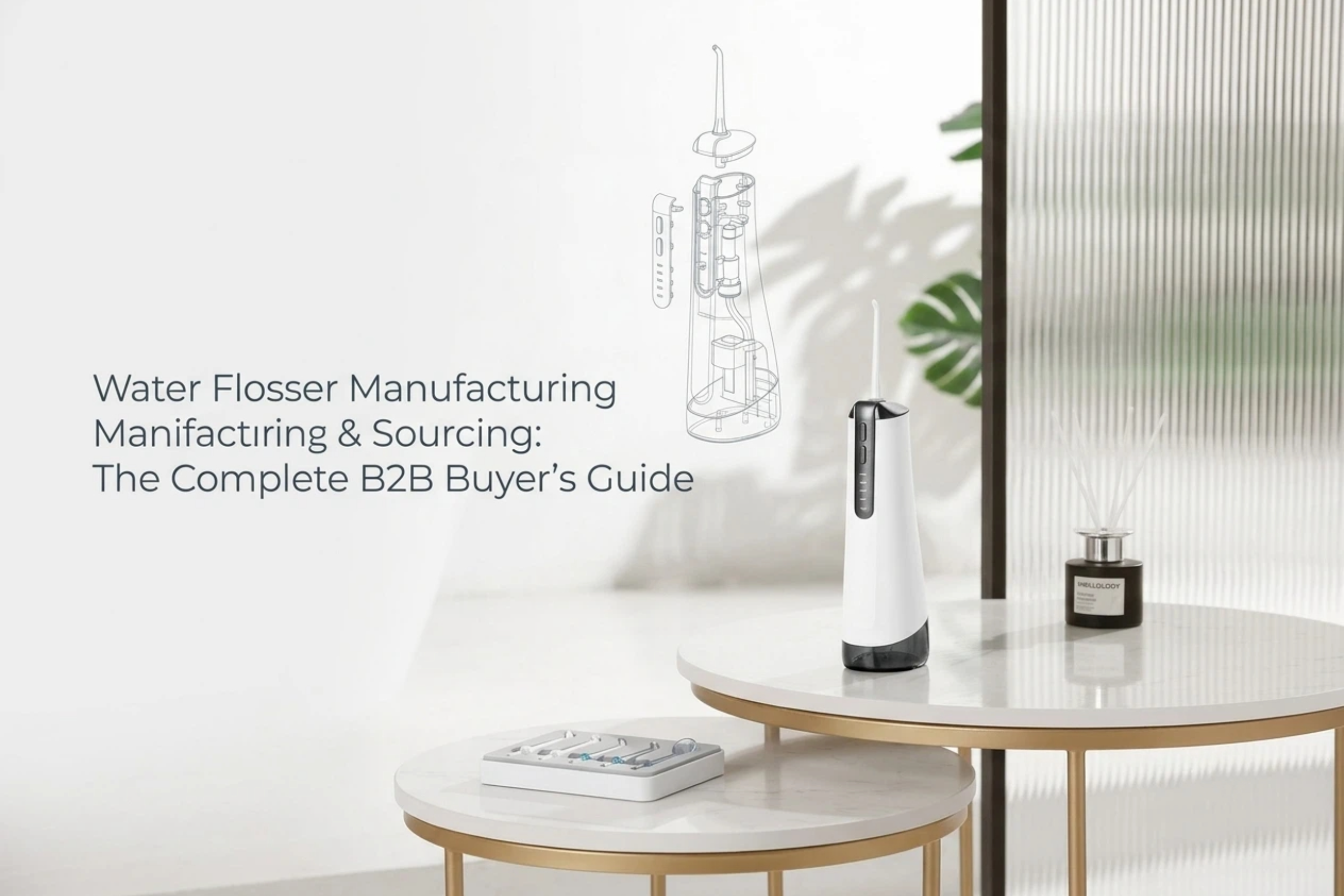
The global water flosser market is projected to surpass $1.4 billion by 2030, driven by rising oral health awareness, expanding retail channels, and the growth of private-label personal care brands. For B2B buyers — whether you are launching a DTC oral care brand, sourcing for retail distribution, or expanding a dental supply catalog — understanding how water flossers are manufactured and sourced is the difference between a profitable product line and a shelf-warming SKU. This guide walks through every stage: product anatomy, OEM vs. ODM models, factory evaluation, MOQ, certifications, quality control, and a step-by-step sourcing process you can follow from brief to delivery.
Oral care has shifted from a commodity category into a wellness-driven market where consumers actively seek better tools. Water flossers — also called oral irrigators — sit at the intersection of preventative dental care and lifestyle wellness, which is exactly where margin growth is strongest.
Several forces are pushing B2B demand upward:
For buyers, the takeaway is clear: water flossers are no longer a niche dental product. They are a mainstream personal care device category with multiple viable B2B channels. The question is not whether to enter the category, but how to source the right product from the right manufacturer.
Ready to Source Water Flossers for Your Brand?
Get OEM/ODM pricing, MOQ details, and customization options from WELLAND’s sourcing team.
Before evaluating suppliers, buyers need to understand what goes into a water flosser. The product is deceptively simple from the outside, but the engineering inside determines performance, durability, and certification outcomes.
| Component | Function | Material Notes for B2B Buyers |
|---|---|---|
| Motor & Pump Assembly | Generates pulsating water pressure (typically 30–100 PSI) | Motor quality directly affects noise, lifespan, and pressure consistency. Ask for cycle-test data. |
| Water Reservoir (Tank) | Holds water for flossing session | Cordless models: 150–300ml. Countertop models: 300–650ml. Food-grade ABS or Tritan is standard. |
| Nozzle / Tip | Directs water stream to teeth and gumline | Standard tips are food-grade plastic. Specialty tips include orthodontic, periodontal (pik pocket), and plaque seeker variants. |
| PCB & Electronics | Controls pressure modes, battery management, safety cutoffs | Quality PCBs prevent overcharging, short circuits, and pressure drops during use. |
| Battery | Powers cordless models | Lithium-ion (typically 1200–1500mAh for cordless). USB-C charging is now the market standard. |
| Housing & Shell | Encloses internal components; provides grip and waterproofing | 100% new ABS plastic is the industry baseline. Avoid recycled material — it compromises structural integrity and certification. |
| Seals & Gaskets | Prevent water ingress into electronics | Silicone O-rings and ultrasonic welding ensure IPX7 waterproofing. This is the #1 failure point in low-quality units. |
Understanding these components matters because every sourcing decision — from material grade to motor specification — flows from this anatomy. When you brief a manufacturer, you are essentially specifying each of these components. A supplier that cannot discuss motor cycle life, PCB protection circuits, or seal testing in detail is not equipped for OEM-grade production.
For a deeper look at how pressure modes translate to product positioning, see our guide on water flosser pressure settings explained. And if you are weighing form factors, our comparison of cordless vs. countertop water flossers breaks down which type fits which retail channel.
Two manufacturing models dominate the water flosser B2B landscape. Picking the right one early saves months of development time and thousands in tooling costs.
In an OEM arrangement, the manufacturer produces a product based on your design, specifications, or modifications to an existing platform. You own the brand and the product definition; the factory provides production capability. OEM is ideal when you have a clear product spec, want control over features and materials, or need to modify an existing design (custom tank size, different pressure modes, branded housing).
In ODM, the manufacturer designs the product and you apply your branding. This is faster to market and requires less engineering investment from your side. ODM works well for brands entering the category without an in-house product team, or for retailers that need a proven, certified product quickly.
| Dimension | OEM | ODM |
|---|---|---|
| Design Control | Full — you define specs | Limited — factory design with your branding |
| Time to Market | Longer (8–16 weeks for custom tooling) | Faster (4–8 weeks for branding + packaging) |
| Tooling Investment | Higher (custom molds) | Lower (existing molds) |
| MOQ | Higher (typically 3,000+ units) | Lower (can start at 500–1,000 for stock models) |
| Best For | Established brands with product teams | New entrants, retailers testing the category |
WELLAND supports both models through its OEM/ODM services, covering everything from concept design and mold development to mass production and custom packaging. The right choice depends on your timeline, budget, and how much product differentiation your brand strategy requires.
Selecting a manufacturer is the highest-stakes decision in the sourcing process. A good partner reduces risk, protects margins, and helps you scale. A poor one delivers defective products, missed deadlines, and compliance gaps that can get your listings pulled from Amazon or rejected by retail buyers.
For a structured approach, follow our 20-point factory evaluation checklist for personal care product manufacturers in China. And to see what a capable manufacturer’s internal operations look like, read our guide on WELLAND’s OEM/ODM manufacturing capabilities.
Explore WELLAND’s Water Flosser Collection
Browse our IPX7-certified cordless water flossers, built for OEM and private-label programs.
Understanding the financial and logistical realities of water flosser sourcing helps you budget accurately and avoid surprises mid-project.
MOQ for water flossers varies by customization level:
At WELLAND, the standard MOQ for most water flosser models is 3,000 pieces, reflecting the tooling and setup costs involved in producing certified personal care electronics at scale.
Typical production lead times after deposit and spec confirmation:
Peak season (August–November) adds 10–15 days. If you are targeting Q4 retail launches or holiday promotions, place orders by mid-July at the latest.
Unit pricing depends on several variables that buyers should negotiate explicitly:
Always request an itemized quote that separates unit cost, tooling amortization, packaging, certification, and freight. This transparency lets you compare suppliers on an apples-to-apples basis and identify where costs can be optimized.
Certifications are non-negotiable for B2B water flosser sourcing. Without them, you cannot list on major e-commerce platforms, pass retail buyer compliance audits, or legally sell in regulated markets. Here is what you need by region:
| Market | Required Certifications | Notes |
|---|---|---|
| European Union & UK | CE, RoHS, REACH | CE marking is mandatory. RoHS restricts hazardous substances in electronics. REACH applies to chemical safety. |
| North America (US/Canada) | FCC, FDA-registered facility, UL (optional but preferred) | FCC covers electromagnetic compliance. FDA facility registration is required for medical-adjacent devices. |
| South Korea | KC certification | Mandatory for electronics sold in the Korean market. |
| Japan | PSE mark | Required for electrical appliances. Suppliers must support PSE testing if targeting Japan. |
| Global (retail buyers) | BSCI or SEDEX audit | Major European retailers (ALDI, Lidl, Rossmann) require social compliance audits. |
| Global (materials) | PAH (Polycyclic Aromatic Hydrocarbons) | Required for products with prolonged skin contact. Increasingly demanded by EU retail buyers. |
WELLAND’s water flossers carry CE, RoHS, FCC, and PAH certifications, and the factory holds ISO 9001, ISO 14001, and BSCI audits. You can download certification documentation directly from our certifications download page. For a broader view of compliance requirements across personal care electronics, our guide on CE, RoHS, and FCC certification for importers applies the same framework.
Water flossers operate in wet environments with internal electronics — a combination where quality failures are costly and dangerous. A single batch of leaky units can trigger Amazon returns, retail chargebacks, and in worst cases, safety incidents. Quality control is not a checkbox; it is the backbone of a sustainable private-label program.
A capable manufacturer applies quality control at five distinct stages:
For buyers, the key question to ask any supplier is: “Can I see your QC records from the last three production runs?” A factory that can produce dated, detailed inspection records is a factory that takes quality seriously. One that cannot — or will not — is a red flag, regardless of how competitive their pricing looks.
See Our IPX7 Water Flosser in Detail
Full specifications, certification data, and customization options for our flagship cordless water flosser.
Customization is where a commodity product becomes a brand. The level of customization you choose directly affects MOQ, lead time, and unit cost — so it pays to understand what is possible and what matters most.
| Customization Level | What’s Included | Impact |
|---|---|---|
| Logo & Color | Pad-printed logo on housing, custom housing color (Pantone matched) | Lowest cost and fastest turnaround. MOQ as low as 1,000 units. |
| Packaging | Custom retail box, branded manual, warranty card | Essential for retail shelf placement. Adds 7–14 days to production. |
| Accessory Bundle | Extra nozzles, travel case, USB-C cable, branded storage bag | Increases AOV and perceived value. Allows tiered SKU strategy (standard / deluxe). |
| Spec Modification | Different tank capacity, pressure modes, nozzle types, battery size | Requires tooling changes. Higher MOQ (3,000+) and longer lead time. |
| Full Custom Design | Unique product shape, custom mold, proprietary PCB, exclusive nozzle design | Maximum differentiation. Requires 5,000+ MOQ and 60–90 day development cycle. |
For most B2B buyers entering the water flosser category, starting with logo, color, and packaging customization on a proven ODM platform is the smartest path. It gets you to market quickly with a certified, tested product while keeping upfront investment manageable. Once you have sales data and customer feedback, you can invest in spec modifications or full custom designs for your next product iteration.
A structured sourcing process reduces risk and keeps projects on schedule. Here is the workflow that experienced B2B buyers follow:
Document your target market, retail channel, desired product type (cordless or countertop), key specifications (tank size, pressure modes, battery), expected volume, and timeline. The more specific your brief, the faster a manufacturer can provide an accurate quote.
Identify 3–5 manufacturers with relevant certifications, production capability, and client portfolios. Request factory audits, certification documents, and reference samples. Apply the factory evaluation checklist mentioned earlier.
Get itemized quotes from shortlisted suppliers. Order reference samples (existing products) to evaluate build quality, pressure performance, noise level, and waterproofing. This is also the time to discuss customization options and MOQ flexibility.
Once you select a supplier, request a customized prototype (golden sample) that reflects your final spec — including logo, color, packaging, and accessories. Test it thoroughly: run pressure tests, charge cycles, waterproofing verification, and cosmetic inspection. The golden sample is your contractual reference standard for mass production.
Lock down the final spec sheet, packaging artwork, certification scope, and pricing. Sign the purchase order, pay the deposit (typically 30%), and confirm the production schedule.
During production, maintain communication with your account manager. Request in-process photos, QC reports, and if possible, schedule a third-party inspection at 80% production completion. This catches issues before shipment, when corrections are still feasible.
Before shipment, conduct or commission a Final Random Inspection (FRI) based on AQL standards. Verify packaging, labeling, accessory completeness, and documentation (certificates, test reports, manuals). Approve shipment, arrange freight (FOB, EXW, or DDP depending on your logistics setup), and track delivery.
After receiving goods, distribute to your channels and collect customer feedback. Share quality issues, return data, and feature requests with your manufacturer to inform the next production run. The best B2B relationships are iterative — each order refines the product based on real market data.
Start Your Water Flosser Sourcing Project Today
Share your product brief, target volume, and customization needs. WELLAND’s sourcing team responds within 24 business hours.
Even experienced buyers make predictable errors when sourcing water flossers. Recognizing these pitfalls before you commit can save significant time and capital.
Price differences between suppliers often reflect material quality, testing rigor, and certification authenticity. A supplier offering 20% lower unit cost may be using recycled ABS, skipping waterproof testing, or providing counterfeit certificates. The cost savings evaporate with the first batch of returns or a rejected Amazon listing.
Under time pressure, some buyers approve production based on a reference sample (the factory’s existing product) rather than a customized golden sample. This is risky because the factory’s stock product may differ subtly from your customized version in color match, logo placement, or packaging fit. Always approve a golden sample that represents exactly what mass production will deliver.
Buyers often assume that if a factory has CE and FCC, they are covered for all markets. But Amazon may require additional documentation, retail buyers may demand BSCI audits, and certain markets (Korea, Japan) need country-specific certifications. Map your certification requirements to your target channels before placing an order.
Water flossers are heavy, water-filled products that experience rough handling in transit. Flimsy packaging leads to crushed boxes, scratched housings, and broken reservoirs — even when the product itself is fine. Invest in drop-tested retail packaging, even if it adds $0.50–$1.00 per unit.
Trusting a factory’s self-reported QC without independent verification is a gamble. A $300–$500 third-party inspection at 80% production completion is the cheapest insurance policy in B2B sourcing. It catches issues while corrections are still possible, rather than discovering them after goods arrive at your warehouse.
MOQ ranges from 500–1,000 units for stock ODM models with basic branding, to 3,000–5,000+ units for full custom OEM projects with new molds and proprietary designs. At WELLAND, the standard MOQ for most water flosser models is 3,000 pieces, reflecting the tooling and setup costs involved in certified personal care electronics production.
Lead time depends on customization level. Stock ODM models typically ship in 25–35 days. Modified OEM orders (custom color, packaging) take 35–45 days. Full custom ODM projects with new molds require 60–90 days, including mold development, sampling, and certification testing. Peak season (August–November) adds 10–15 days to all timelines.
Amazon requires FCC compliance for the US market and CE for the EU market, at minimum. RoHS compliance is increasingly enforced. For Amazon’s European marketplaces, you may also need DoC (Declaration of Conformity) and test reports from accredited labs. Some categories require additional safety documentation. Always confirm current requirements with Amazon Seller Support before listing.
It depends on your target channel. Cordless models suit travel retail, e-commerce DTC brands, hotel amenity programs, and corporate gifting. Countertop models are better for pharmacy chains, dental clinic supply, and home appliance retail. Many brands source both types to create a good/better/best shelf strategy. See our cordless vs. countertop comparison guide for a detailed channel-by-channel breakdown.
Yes. Standard customization includes color-matching nozzle tips to your brand and bundling different tip types (precision, orthodontic, periodontal). For fully proprietary nozzle designs, new tooling is required, which increases MOQ and lead time. Nozzle material is typically food-grade plastic; discuss specific material requirements with your manufacturer during the spec phase.
OEM (Original Equipment Manufacturing) means the factory produces to your design specification — you control the product definition. ODM (Original Design Manufacturing) means the factory designs the product and you apply your branding. OEM offers more differentiation but requires higher investment and longer timelines. ODM is faster to market with lower upfront cost. See our detailed comparison of OEM vs. ODM manufacturing models for a full breakdown.
Waterproofing is achieved through a combination of silicone O-ring seals, ultrasonic welding of housing seams, and IPX7-rated design. On the production line, 100% of units undergo waterproof testing — typically submersion or pressurized water exposure — to verify seal integrity. This is the single most critical QC step in water flosser manufacturing, as water ingress into the electronics compartment is the leading cause of product failure.
A strong brief includes: target market and retail channel, product type (cordless/countertop), key specs (tank capacity, pressure modes, battery type), expected annual volume, customization requirements (logo, color, packaging, accessories), certification needs, target price point, and desired launch timeline. The more specific your brief, the faster and more accurate the supplier’s response will be.
Yes. WELLAND’s water flossers support orthodontic nozzle tips and multiple pressure settings suitable for braces, implants, and periodontal care. For dental clinic supply, we recommend models with broader pressure ranges. See our guide on the best water flosser for braces for clinical positioning strategies and OEM specifications.
Sourcing a water flosser for your brand is a multi-stage process, but it does not have to be a guessing game. Define your product brief, evaluate manufacturers against the criteria in this guide, and follow the step-by-step process from sample approval to final inspection. The right manufacturing partner — one with certified production, rigorous quality control, and responsive communication — turns water flosser sourcing from a risk into a repeatable growth engine for your brand. WELLAND has been that partner for 800+ global clients since 2018. Reach out with your brief, and let’s build your product line together.
 EN
EN  RU
RU  PT
PT  FR
FR  ES
ES  KO
KO  JA
JA  DE
DE  ZH
ZH